
Custom Dust Collector Replaces Worn, Non-Compliant Unit
Industry: Mining & Minerals
Application
Gilsonite Vacuum Conveying and Dust Collection
Case Study Highlights
Replaced 35-year-old, non-compliant dust collector
Custom-designed as a direct drop-in replacement
Handles 20 tons of Gilsonite per hour
Abrasion-resistant cyclonic inlet reduces component wear
Installation completed in three days
Expected filter life increased to at least two years

The Challenge:
Replacing a Worn Dust Collector in a Restricted Space
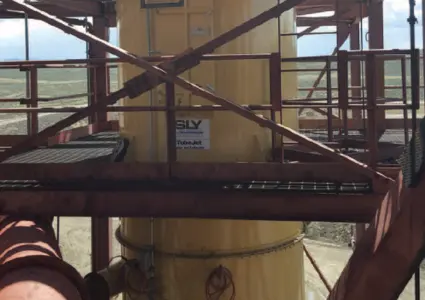
American Gilsonite Company (AGC) used a dust collector as a filter receiver in a vacuum conveying system moving 20 tons of Gilsonite per hour from a 1,800-ton silo to a 60-ton surge bin 250 feet away. After years of operation, the 35-year-old collector had experienced significant abrasion and no longer met current combustible dust design standards.
Challenges included:
- Tangential inlet caused repeated abrasion to housing walls
- Poor inlet placement contributed to premature filter bag failure
- Existing collector could not be reworked for compliance
- Restricted installation area required a drop-in replacement
AGC also needed to complete the replacement quickly to limit plant downtime.
The Solution:
Custom CBR TubeJet® Baghouse Dust Collector
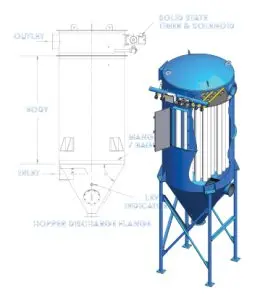
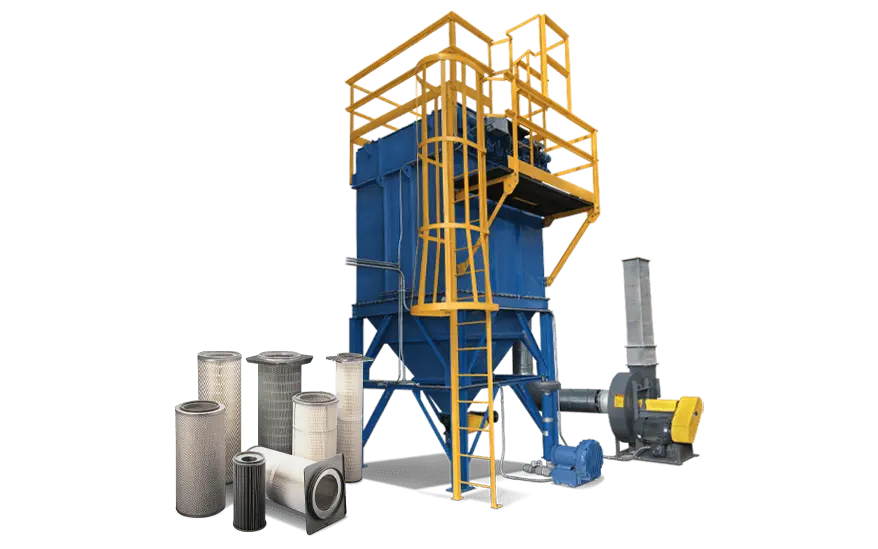
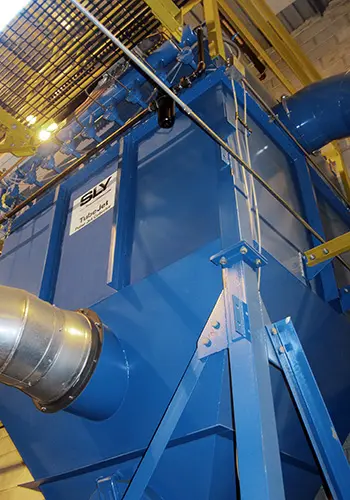
Sly recommended a CBR TubeJet® baghouse dust collector customized with support legs to match the physical dimensions of the existing unit. The system maintained the required filter area while incorporating abrasion-resistant construction and updated combustible dust explosion protection.
This approach provided several advantages:
- Cyclonic inlet reduces direct abrasion inside the collector
- Internal cyclone ring protects housing walls and filter bags
- Bolt-on abrasion-resistant inlet and hopper increase service life
- Custom dimensions allow installation within the existing footprint
The collector also uses a pulse-jet cleaning system with an adjustable solid-state timer to remove material collected on the filters.
System Specifications
Product
CBR TubeJet® baghouse dust collector
Conveying Distance
250 feet
Cleaning System
Adjustable pulse-jet filter cleaning
Material Flow
20 tons of Gilsonite per hour
Construction
1/4-inch abrasion-resistant steel inlet and hopper
Explosion Protection
MSHA/OSHA compliant per NFPA 654, 68, 69
The Results:
Faster Installation and Improved Wear Protection
AGC completed the dust collector replacement ahead of its planned shutdown schedule while improving abrasion resistance and combustible dust protection.
Key Results:
- Installation completed in three days instead of four
- One full day of plant shutdown avoided
- Abrasion-resistant cyclone ring protects housing and filters
- Expected filter replacement interval increased from one to two years
- New collector meets applicable combustible dust design requirements
Why CBR TubeJet® Baghouse Dust Collectors Work for Gilsonite Dust Collection Applications
Gilsonite produces significant amounts of explosive dust during processing and can be sticky, requiring sufficient filter surface area to maintain airflow through the baghouse. In this application, the CBR TubeJet® baghouse combined the required filter area with a cyclonic inlet, internal cyclone ring, abrasion-resistant construction, pulse-jet cleaning, and combustible dust explosion protection.
FAQs
What type of dust collector can be used for Gilsonite processing?
In this application, AGC selected a CBR TubeJet® baghouse dust collector for a vacuum conveying process handling Gilsonite. The system provided the required filter area, abrasion protection, and combustible dust explosion protection.
How can a baghouse reduce abrasion from conveyed materials?
The system used a cyclonic inlet and internal cyclone ring to reduce wear on the collector housing and adjacent filter bags. The inlet and hopper were also constructed from 1/4-inch-thick abrasion-resistant steel.
Why is filter area important when collecting sticky dust?
According to AGC, Gilsonite is somewhat sticky and requires additional filter surface area to maintain high airflow through the baghouse.
Can a dust collector be customized to replace existing equipment?
Yes. In this case, Sly customized the collector and support legs to match the dimensions of the existing unit, allowing it to fit within a restricted installation area.
What explosion protection considerations apply to combustible dust collectors?
The replacement collector in this application was designed for combustible dust explosion protection and was described as MSHA/OSHA compliant according to NFPA 654, 68, and 69.
Why Sly?

Sly worked with AGC to develop a customized dust collection system that matched the dimensions of the existing equipment while addressing abrasion, filter wear, installation constraints, and combustible dust protection requirements. The custom fabrication allowed the new baghouse to serve as a direct replacement within the plant’s restricted installation space.