

Why a Maintained Baghouse is a Productive Baghouse
A baghouse maintenance checklist ensures your dust collection system runs efficiently, safely, and in compliance with environmental regulations. Without regular maintenance, you risk costly downtime, reduced performance, and potential safety hazards.
Quick Reference: Essential Baghouse Maintenance Tasks
| Frequency | Key Tasks |
|---|---|
| Daily | Monitor differential pressure (3-6″ w.c.), check exhaust stack for visible emissions, verify hopper discharge, listen to cleaning cycle |
| Weekly | Inspect cleaning sequence and valves, check fan components and hoses, blow out differential pressure gauge lines |
| Monthly | Check bag tension (shaker/reverse-air), inspect dampers and timer board, examine fan for corrosion |
| Quarterly | Inspect door gaskets, thoroughly check filter bags and cages, examine ducts for dust buildup |
| Annual | Inspect hoppers for wear, check all welds and bolts, assess structural integrity and corrosion |
Your baghouse is the workhorse of your air pollution control system, capturing dust, ensuring compliance, and protecting worker health. When maintenance is neglected, problems compound quickly.
The stakes are high. Poor maintenance leads to sluggish performance, unexpected breakdowns, and costly emergency repairs. A malfunctioning baghouse poses serious health risks and may result in EPA fines if emission standards aren’t met. For context on how dust collection fits into broader air quality management, see the background information on industrial dust collection.
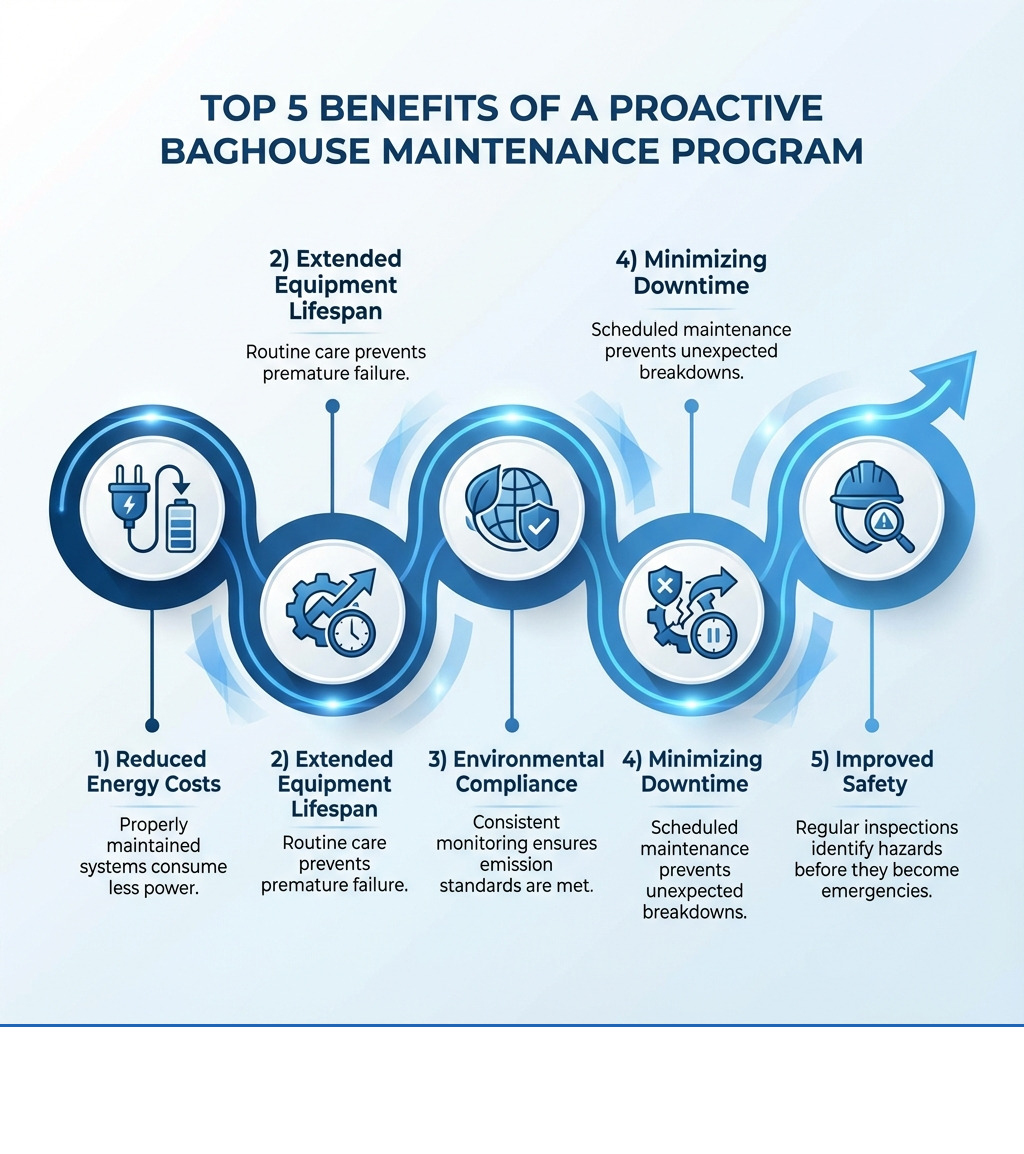
The good news? A routine inspection and maintenance program positively impacts equipment performance and extends its life. Regular maintenance reduces energy costs, prevents disruptions, and helps avoid massive, difficult cleanouts.
This comprehensive guide breaks down exactly what you need to inspect, when to inspect it, and how to develop a maintenance program that keeps your baghouse running at peak efficiency.
Key Indicators Your Baghouse Needs Immediate Maintenance
Baghouse systems are the unsung heroes of air purification. Like any critical machinery, they show signs when something is wrong. Interpreting these signals is crucial for timely intervention and preventing minor issues from becoming major headaches.
So, what are the key indicators that suggest your baghouse requires immediate maintenance? We’re looking for anything out of the ordinary:
- Visible emissions or dust plumes: This is perhaps the most glaring red flag. If you see dust escaping from your exhaust stack, it indicates a breach, such as a broken filter bag or tubesheet issue. This signifies poor filtration, potential environmental compliance violations, and health risks.
- Unusual noises: A healthy baghouse operates with a predictable hum. Any new grinding, squealing, clunking, or excessive pulsing sounds can point to problems with fans, cleaning mechanisms, rotary airlock valves, or other moving parts.
- Abnormal pressure readings: We’ll dive deeper into differential pressure in a moment, but significant deviations from your normal operating range are a critical warning sign.
- Reduced airflow at pickup points: If your dust collection hoods aren’t capturing dust effectively, it could indicate a blockage in the ductwork, a fan issue, or severely clogged filter bags.
- Signs of corrosion: Rust or pitting on the baghouse exterior or internal components can compromise structural integrity and lead to leaks or failures. This is especially concerning in environments with corrosive dusts or high moisture.
- Dust accumulation in ductwork: While ductwork is designed to transport dust, excessive buildup indicates insufficient airflow velocity, which can lead to blockages, increased pressure drop, and reduced collection efficiency.
These signs are often your first clue that something needs attention, and ignoring them can lead to significant issues, including those outlined in our guide on 6 Signs of an Unsafe Dust Collection System.
Monitoring Differential Pressure for Baghouse Maintenance
Differential pressure (DP) is like the pulse of your baghouse – it tells us a lot about its health. It’s the measurement of the pressure difference between the dirty air inlet side and the clean air outlet side of your filter bags. This reading indicates the resistance to airflow through the filter media, primarily caused by the accumulated dust cake on the bags.
Why is it a key health indicator? A rising differential pressure typically means more dust is accumulating on the filter bags, making it harder for air to pass through. This is normal to a certain extent, as a dust cake is necessary for efficient filtration. However, if the DP rises too high, it signals that the bags are becoming excessively clogged or “blinded,” and the cleaning system isn’t effectively removing the dust.
The normal operating range for a baghouse’s differential pressure is typically between 3″ – 6″ of water column (w.c.). This range can vary based on your specific baghouse design, application, and filter media. We always recommend consulting your manufacturer’s specifications for precise targets.
What causes deviations?
- High DP: Can be caused by an excessive dust cake (indicating a cleaning system malfunction or insufficient cleaning frequency), blinding of the filter media (often due to moisture or improper dust characteristics), or even an overload of dust in the system.
- Low DP: Conversely, an unusually low DP can be a sign of trouble, too. It might indicate a major leak in the system, such as a broken filter bag, a hole in the tubesheet, or a bypass damper stuck open, allowing dirty air to bypass the filters entirely.
Regularly monitoring and logging your differential pressure readings is one of the simplest yet most effective ways to track your baghouse’s performance over time. Deviations from the norm can alert us to problems before they become critical. For an even deeper dive into this vital metric, explore How to Monitor Baghouse Health Through Differential Pressure.
The Ultimate Baghouse Maintenance Checklist by Frequency
Adhering to a comprehensive baghouse maintenance checklist is paramount for the longevity and optimal performance of your dust collection system. Think of it as a health plan for your baghouse, with routine check-ups and preventative care designed to keep it in top shape.
While many maintenance tasks are universal, the specifics of your baghouse’s design – whether it’s a pulse-jet, reverse-air, or shaker system – will influence your checklist. Each type has unique components and cleaning mechanisms that require custom attention. For more insights on keeping your system running smoothly, check out our resources on Dust Collector Maintenance.
Your Daily Baghouse Maintenance Checklist
Our daily checks are quick, visual inspections and readings that give us an immediate snapshot of the baghouse’s health. These are your first line of defense against brewing problems.
- Check differential pressure: Record the DP reading. Is it within the normal operating range (typically 3-6″ w.c.)? Is it consistently trending upward or downward?
- Inspect exhaust stack for visible emissions: Look for any dust plumes or opacity. This is a critical indicator of bag failure.
- Monitor hopper discharge device: Ensure the dust is flowing freely from the hopper and that the discharge mechanism (e.g., rotary airlock, screw conveyor) is operating without issues. We want to avoid dust bridging or buildup.
- Check compressed air pressure: For pulse-jet systems, confirm that the compressed air supply is at the manufacturer’s recommended pressure. Ensuring the proper supply pressure is critical for effective bag cleaning.
- Listen for cleaning cycle operation: For all cleaning systems, listen to ensure the cleaning sequence is engaging correctly and that all valves are firing as expected (for pulse-jet) or that the shaker/reverse-air mechanisms are operating smoothly.
Essential Daily Monitoring Tools:
- Pressure gauge (manometer, Magnehelic®, Photohelic® Gauge)
- Opacity monitor (if installed)
- Visual inspection (our own two eyes!)
Weekly & Monthly Checks
As we move to weekly and monthly inspections, we start to look a little deeper, ensuring the operational components are functioning correctly and catching wear before it causes a breakdown.
Weekly Checks:
- Check cleaning sequence: Verify that the cleaning system (pulse-jet, reverse-air, or shaker) is cycling through all compartments or rows of bags in the correct sequence and at the appropriate intervals. Determine that all valves seat properly, preventing air leakage.
- Inspect fan and drive components: Visually check the fan motor and fan drive components for any signs of wear, unusual vibrations, or excessive heat. Ensure belts (if applicable) are taut and in good condition.
- Check hoses and air lines: Inspect all hoses, connections, and air lines leading to the baghouse, particularly for pulse-jet systems. Look for leaks, cracks, or signs of wear that could compromise compressed air delivery.
- Blow out gauge lines: For differential pressure gauges, periodically blow out the lines to prevent dust from plugging them and affecting the accuracy of readings.
Monthly Checks: Our monthly checks involve more detailed inspections of critical components, ensuring they are operating efficiently and catching potential issues early. For a deeper dive into monthly tasks, check out Your Monthly Baghouse Maintenance Checklist.
- Spot check bag tension (shaker/reverse air): For shaker and reverse-air baghouses, visually check a few bags to ensure they are properly tensioned. Loose bags can abrade, while overly tight bags can stress the fabric.
- Inspect damper operation: Check all damper operations, including bypass and isolation dampers. Ensure they open and close fully and seat properly when required.
- Check timer board: For pulse-jet systems, inspect the timer board to ensure the cleaning sequence is programmed correctly and functioning as intended.
- Inspect solenoid and diaphragm valves: Monitor the solenoid and specifically diaphragm valves for pulse-jet systems to ensure they are firing properly and not sticking. Listen for consistent operation. Air leaks from solenoids indicate a stuck valve. Air leaks from a diaphragm valve are typically from a torn diaphragm. Both will bleed down the compressed cleaning air in the manifold.
- Check fan for corrosion: Inspect the fan blades and housing for any signs of corrosion or material buildup, which can lead to imbalance and reduced efficiency. Check fan drive components for wear.
Quarterly & Annual Inspections
These less frequent, but more thorough, inspections are crucial for assessing the overall health and structural integrity of your baghouse. They often require more downtime and can be planned during scheduled shutdowns.
Quarterly Checks:
- Inspect door gaskets and seals: Thoroughly inspect all door gaskets and seals for wear, cracks, or hardening. Damaged seals can lead to air leaks, reducing system efficiency and potentially allowing dust to escape.
- Confirm inlet temperature: Verify that the baghouse inlet temperature is within the manufacturer’s recommended range for your filter media. Excessive temperatures can damage bags, while too low can lead to condensation and blinding.
- Thorough filter bag and cage inspection: This is a critical step. We need to perform thorough inspections of all filter bags and cages. Check for wear, tears, holes, and proper seating. Spot check for bag leaks and holes using a leak detection test (e.g., fluorescent leak detection powder). This helps us identify and replace damaged bags before they cause significant emissions. For more on leak detection, see Detecting Leaks in Your Baghouse System Through Dye Testing.
- Check ducts for dust build-up: Inspect the ductwork for any significant dust accumulation. Excessive buildup can impede airflow, increase pressure drop, and reduce capture velocity at pickup points.
- Observe damper valves for proper seating: If applicable, observe the damper valves to ensure they seat properly, preventing air bypass.
Annual Checks: Our annual inspections are the most comprehensive, often requiring a full system shutdown to access internal components and assess structural integrity.
- Inspect internal hoppers for wear: Thoroughly inspect internal hoppers for wear, abrasion, or corrosion, especially the inlet diffuser and areas where dust impacts the walls.
- Check all welds and bolts: Inspect all structural welds and bolts throughout the baghouse structure for signs of cracking, corrosion, or loosening.
- Inspect structure for corrosion: Conduct a detailed inspection of the entire baghouse structure for any signs of corrosion, particularly in areas prone to moisture or chemical exposure.
- Inspect internal baffle plate: If your baghouse has an internal baffle plate, inspect it for wear, abrasion, or damage from incoming dust-laden air.
How to Build a Preventive Baghouse Maintenance Program
Implementing a robust baghouse maintenance plan is a strategic approach to safeguarding your investment, ensuring compliance, and optimizing operational efficiency.
First, we recommend tailoring a maintenance program to your specific dust collection system. No two baghouses are exactly alike, and your plan should reflect your unique operating conditions, dust characteristics, and system design. This includes creating detailed inspection logs for your specific baghouse model.
Record-keeping and logs: This is where the rubber meets the road. Consistent and accurate record-keeping is invaluable. Logging daily differential pressure, noting observations from inspections, and tracking all maintenance activities – from bag replacements to valve repairs – provides a historical record. This data allows us to:
- Identify trends and predict future maintenance needs.
- Troubleshoot recurring issues more effectively.
- Justify budget requests for parts or upgrades.
- Demonstrate compliance with regulatory bodies.
The importance of training: A maintenance plan is only as good as the people executing it. Proper training plays a crucial role in ensuring baghouse operation and maintenance are carried out effectively and safely. Your maintenance staff should be thoroughly trained on your specific plant’s baghouse dust collection and ventilation systems, including:
- Understanding the system’s operational principles.
- Recognizing warning signs and troubleshooting common issues.
- Safe lockout/tagout procedures.
- Proper inspection techniques and use of tools.
- The importance of record-keeping.
Proper start-up procedures for new bags: One often-overlooked aspect of baghouse maintenance is the proper start-up, or “seasoning,” of new filter bags. This initial conditioning is critical for developing a stable dust cake, which is essential for optimal filtration efficiency and extending bag life. We’ll dig deeper into this shortly, but remember, getting this right from the start can prevent premature bag failure and blinding. For detailed guidance, refer to How to Properly Start Up Your Dust Collector or Baghouse.
Filter Bag Inspection and Replacement
The filter bags are the heart of your baghouse, doing the heavy lifting of dust capture. Their condition directly impacts your system’s efficiency and emissions. Therefore, procedures for inspecting and maintaining the filter bags themselves are paramount.
Procedures for inspecting bags:
- Visual Inspection: Regularly inspect bags for visible wear, tears, holes, or abrasions. Look for discoloration or shiny spots that might indicate localized wear or dust impingement.
- Proper Seating: Ensure each bag is properly seated in the tubesheet and secured by its cage (for pulse-jet) or tensioning mechanism (for shaker/reverse-air). Improper seating can lead to bypass air and premature wear.
- Leak Detection: Use methods like fluorescent leak detection powder during a shutdown to pinpoint even tiny leaks or improperly seated bags. This powder is introduced into the dirty air stream, and a UV light reveals where it has passed through.
When to clean vs. replace: This is a common question. While cleaning can extend bag life, there comes a point when replacement is necessary.
- Cleaning: Bags can often be cleaned to restore permeability, especially if they are merely loaded with dust. However, aggressive cleaning can damage the filter media.
- Replacement: Bags should be replaced when they show signs of significant wear, tears, holes, or when they are “blinded” (permanently clogged) and no longer respond to cleaning, resulting in persistently high differential pressure or visible emissions. We typically replace bags in complete sets to maintain consistent performance across the system. For a comprehensive guide, see Baghouse Dust Collector Filters Ultimate Guide, and for reasons to replace, read 3 Reasons to Replace Your Dust Collector Filter Bags.
Maintaining Auxiliary Equipment
A baghouse isn’t just about the bags; it’s a complex system supported by various auxiliary components that all need attention. Neglecting these can undermine the performance of even the most well-maintained filter bags.
- Fans and blowers: These are the lungs of your system, creating the airflow needed to draw dust-laden air into the baghouse. Best practices include:
- Regularly checking for unusual noises or vibrations.
- Inspecting fan blades for wear, corrosion, or material buildup that can cause imbalance and reduce efficiency.
- Checking motor bearings for proper lubrication and wear.
- Ensuring drive belts are correctly tensioned and free from cracks or fraying.
- Hoppers and discharge devices: The hopper collects the dust, and the discharge device (like a rotary airlock valve or screw conveyor) removes it from the system.
- Inspect hoppers for dust bridging or buildup, which can block discharge and stress the system.
- Check discharge devices for wear, proper sealing, and smooth operation. Any leaks here can draw in ambient air, affecting system performance.
- Ductwork inspection: The ductwork transports dust from the source to the baghouse.
- Periodically inspect for dust accumulation, especially in horizontal runs or elbows. Standard practice suggests maintaining an airstream velocity of at least 3500 feet per minute (fpm) to prevent dust from settling.
- Look for physical damage, leaks, or corrosion that can reduce airflow or allow dust to escape.
- Dampers: These control airflow within the system. Ensure they open, close, and seal properly. Malfunctioning dampers can lead to imbalanced airflow or bypass.
- Rotary airlocks: If your system uses rotary airlock valves for continuous dust discharge, inspect their seals and internal components for wear. Worn airlocks can leak air, reducing the negative pressure in the baghouse.
All these components are crucial, and we offer a range of replacement parts to keep your entire system functioning optimally.
Frequently Asked Questions about Baghouse Maintenance
How do cleaning systems (pulse-jet, reverse air, shaker) affect maintenance?
The type of cleaning system your baghouse employs significantly influences the specific maintenance procedures and their frequency. Each system has unique components that require specialized attention.
- Pulse-jet baghouses: These systems use short bursts of compressed air to dislodge dust from the filter bags.
- Maintenance focus: Our primary focus here is on the compressed air system’s components, including solenoid valves and diaphragm valves. We need to ensure these valves are firing correctly, quickly, and consistently. We inspect them for wear, sticking, or leaks. Maintaining the quality of your compressed air (dry and oil-free) is vital to prevent moisture and oil from blinding filter bags and damaging valve components.
- Internal Link: For more details, explore Pulse Jet Filter Cleaning.
- Reverse-air baghouses: These systems use a reverse flow of low-pressure air to inflate and collapse the bags, dislodging dust.
- Maintenance focus: Key maintenance areas include checking bag tensioning (as bags can stretch over time), inspecting reverse-air dampers for proper operation, and monitoring the reverse-air fan or blower.
- Shaker baghouses: These systems use a mechanical shaking mechanism to dislodge dust from the bags.
- Maintenance focus: The emphasis is on the mechanical components – motors, shafts, bearings, and linkages – that create the shaking motion. We inspect these for wear, proper lubrication, and alignment, and ensure bags are correctly tensioned to allow for effective shaking without abrasion.
Understanding your specific cleaning system is the first step to creating an effective maintenance schedule.
Why is a “dust cake” important for new filter bags?
When you install new filter bags, they are clean and highly permeable. While this might sound ideal, a “virgin” bag isn’t as efficient at capturing very fine particles as a bag that has been properly conditioned. This is where the “dust cake” comes in.
- Function of a dust cake: A dust cake is the porous layer of collected particulate that develops on the surface of the filter media during the initial period of operation. This dust layer acts as a secondary filter, dramatically increasing the bag’s efficiency, especially for sub-micron particles. Without it, fine dust can “bleed through” the new filter media.
- Seasoning/conditioning new bags: This critical start-up procedure involves gradually introducing dust-laden air to new bags, often by running the system at reduced airflow (e.g., partially closing fan dampers) and delaying the cleaning cycle. This allows a stable, permeable dust cake to form gently, rather than being forced onto the bags, which could lead to blinding.
- Preventing blinding: Blinding occurs when fine particles, moisture, or oil permanently clog the pores of the filter media, making it impenetrable to air. Proper seasoning prevents this by building a controlled dust cake.
- Extending bag life: A well-formed dust cake protects the filter media from direct impingement by abrasive particles, extending the lifespan of your expensive filter bags.
The dust cake is your baghouse’s secret weapon for high-efficiency filtration. Neglecting proper seasoning can lead to poor performance from day one and significantly shorten the life of your bags. For more information, check out A Deep Dive into Filter Bags for Dust Collection Systems.
How does maintenance ensure environmental and safety compliance?
Proper baghouse maintenance is not just about keeping your equipment running; it’s fundamental to ensuring environmental compliance and safeguarding the health and safety of your workforce.
- Meeting EPA emission limits: Our baghouses are designed to capture dust and particulate matter, preventing it from being released into the atmosphere. Regular maintenance ensures that the system operates at its designed efficiency, consistently meeting or exceeding EPA emission limits. An improperly functioning system can lead to violations and monetary fines from environmental agencies.
- Preventing visible emissions: Visible emissions from the stack are a clear sign of a problem, usually a broken bag. Promptly addressing these issues through diligent maintenance ensures we stay within regulatory limits and avoid public scrutiny.
- NFPA standards for combustible dust: For processes involving combustible dust, proper baghouse maintenance is a critical component of explosion prevention and compliance with NFPA (National Fire Protection Association) standards. This includes regular cleaning to prevent dust accumulation, inspecting components for potential ignition sources, and ensuring safety devices (like explosion vents) are functional. Our article on How to Ensure NFPA and OSHA Compliance in Your Dust Collection System provides more insights.
- Worker health and safety: Dust and particulate matter can pose significant health risks, including respiratory illnesses and skin irritation. A well-maintained baghouse effectively captures these hazards, protecting everyone in the vicinity. Neglecting maintenance means exposing workers to unsafe air quality, which can lead to OSHA violations and serious health consequences. Cleaning a neglected baghouse is not just dirty; it’s a health and safety challenge. Proactive maintenance minimizes these risks.
- Avoiding fines: Beyond environmental penalties, safety lapses due to poor maintenance can result in significant fines and legal liabilities. A robust baghouse maintenance checklist helps us stay proactive and compliant.
A carefully maintained baghouse is a testament to our commitment to responsible industrial operations, protecting both our people and our planet.
Conclusion: Achieve Peak Performance with Proactive Maintenance
We’ve journeyed through the intricate world of baghouse maintenance, exploring everything from daily checks to annual overhauls, the nuances of different cleaning systems, and the critical role of the humble dust cake. The message is clear: proactive maintenance is not merely a task; it’s an investment that pays dividends in operational efficiency, cost savings, and unparalleled peace of mind.
By diligently following a comprehensive baghouse maintenance checklist, we ensure our systems run at peak performance, capturing dust effectively, protecting our workforce, and safeguarding our environment. This proactive approach prevents unexpected breakdowns, extends the lifespan of our equipment, and ultimately contributes to a more productive and compliant operation.
For over a century, Sly, LLC has pioneered air pollution control, providing robust and reliable dust collectors designed for longevity and peak performance. Our commitment is to deliver no-compromise solutions for the cleanest air possible, and we believe that a well-maintained system is the cornerstone of achieving that goal. Accept the power of a proactive maintenance program, and experience the true bliss of a perfectly performing baghouse.