
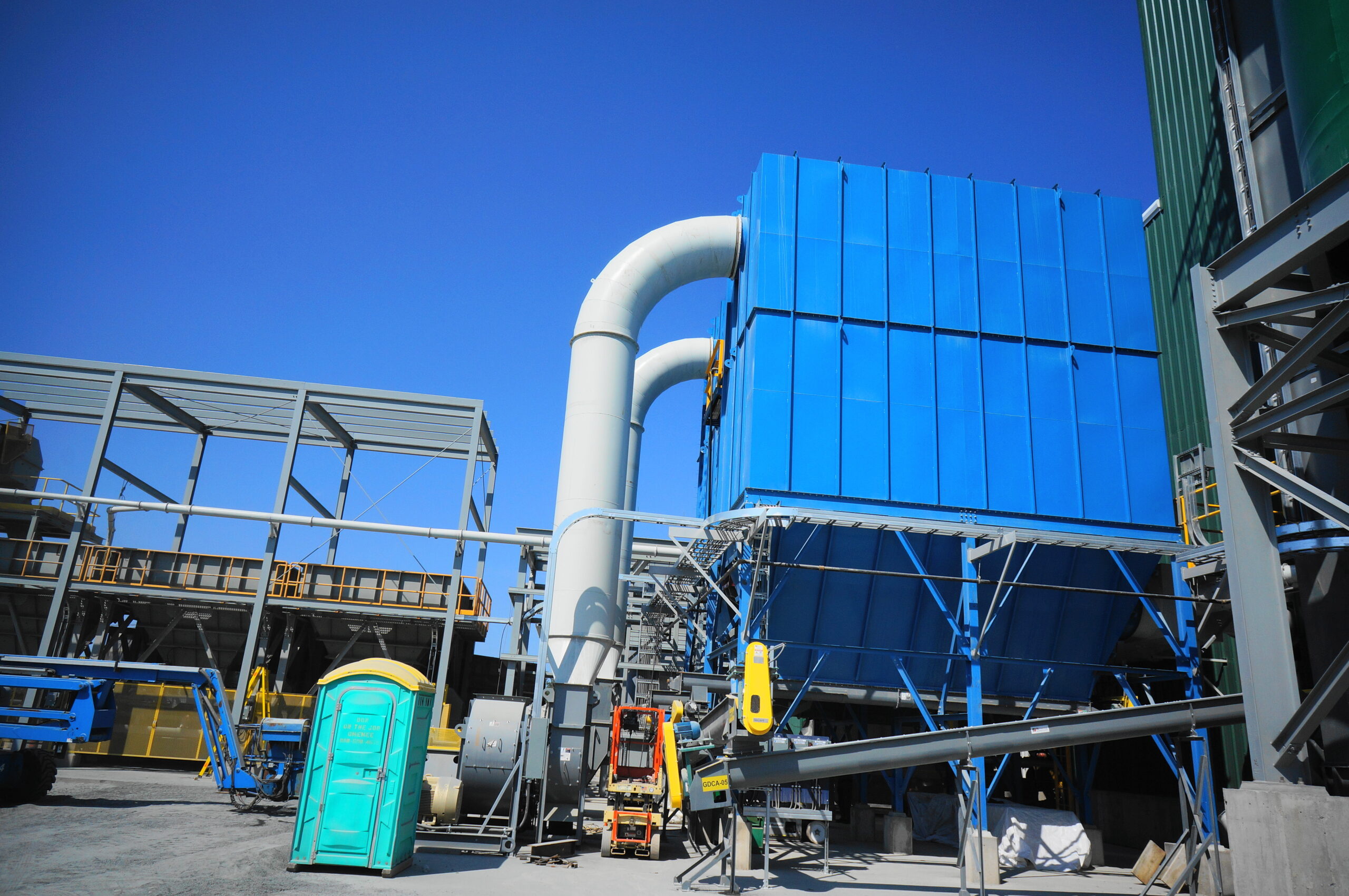
Why Industrial Facilities Need Reliable Dust Control Systems
Industrial dust collection systems are engineered to capture, transport, filter, and contain airborne particulate matter generated during manufacturing and processing. These systems are crucial for protecting worker health, ensuring regulatory compliance, preventing combustible dust explosions, and improving operational efficiency.
Core components of a dust collection system:
- Source capture: Hoods and enclosures at the point of dust generation.
- Air movement: Fans and ductwork to transport contaminated air.
- Filtration: Baghouses, cartridge collectors, or wet scrubbers to remove particles.
- Cleaned air discharge: Returning filtered air to the facility or exhausting it outside.
- Dust disposal: Hoppers and conveyors for safe material removal.
Without proper control, industrial dust can lead to health hazards, safety risks, and regulatory violations. Modern dust collection technology, however, can capture over 99% of harmful particles while minimizing energy consumption and maintenance. Choosing the right system for your specific needs is key to a cleaner, safer, and more productive facility.
Beyond the basic building blocks, high-performing systems are engineered as an integrated system. Effective source capture relies on properly designed hoods and adequate capture velocity at the point of generation, while balanced ductwork maintains transport velocities that prevent settling and plugging. The fan must be selected against the total system static pressure, and its performance should be matched to the process operating envelope—often with a variable frequency drive (VFD).
Filtration performance is driven by air-to-cloth ratio, media selection, and the efficiency of the cleaning mechanism. Pulse-jet cleaning, reverse-air, or shaker styles are chosen based on dust characteristics and duty cycle. Where applicable, pre-separation (e.g., cyclones or drop-out boxes) can reduce loading on the primary collector, lowering wear and extending filter life. For combustible dusts, compliant explosion protection and isolation devices must be integrated from the start, not added as an afterthought.
To sustain performance, facilities increasingly employ continuous monitoring—differential pressure to assess filter loading, airflow measurements to verify capture, and broken-bag/leak detection to protect downstream equipment or product quality. Tying these measurements into a plant PLC or building management system enables proactive maintenance and rapid troubleshooting.
Key performance parameters that are commonly tracked during operation include:
- Differential pressure across the collector (filter health and energy impact)
- Capture and transport velocities (process control and plug prevention)
- Emission rates at the outlet (regulatory compliance)
- Compressed air consumption for pulse cleaning (operating cost)
With the right design, controls, and maintenance strategy, dust collection becomes a strategic asset—supporting EHS goals, product quality, and throughput—rather than just a compliance expense.
Why Effective Dust Control is a Business Imperative
Failing to manage industrial dust can have severe consequences, impacting worker health, operational safety, regulatory emission compliance and ultimately your bottom line. An effective industrial dust collection and control system is not just about cleanliness; it’s a critical business investment. For a deeper dive, see our article on industrial dust and dust safety.
Health, Safety, and Regulatory Compliance
Uncontrolled dust poses significant health risks, including respiratory diseases like asthma, bronchitis, and silicosis. It also creates immediate safety hazards by reducing visibility and creating slip-and-fall risks. Government agencies like OSHA and the EPA have strict regulations regarding air quality and dust exposure. Non-compliance can result in heavy fines and operational shutdowns. A properly designed industrial dust collection and control system is essential for meeting these standards and protecting your workforce. Need help navigating the compliance maze? Our OSHA compliance resources can guide you.
For authoritative guidance on exposure limits and control strategies, consult the NIOSH/CDC Dust Control Handbook for Industrial Minerals Dust Control Handbook for Industrial Minerals Mining and Processing and OSHA resources such as the page on respirable crystalline silica. These references complement your internal EHS policies and help align engineering controls with the hierarchy of controls to reduce worker exposure at the source.
Mitigating Combustible Dust Explosions
Many industrial dusts, such as wood, grain, and metal, are combustible. When suspended in the air in a confined space, they can ignite and cause devastating explosions. The “dust explosion pentagon” outlines the five elements needed for this to occur: fuel, oxygen, an ignition source, dispersion, and confinement. A poorly designed dust collector can create this exact scenario.
Proper industrial dust collection and control systems incorporate safety features like explosion venting, isolation devices, and suppression systems to mitigate these risks, ensuring compliance with NFPA standards like NFPA 660.. Learn more in our guide on five key steps towards mitigating combustible dust hazards and explore our resources on explosive dust. For broader background and regulatory context, see OSHA’s overview of combustible dust and NFPA’s page for NFPA 660.
The Economic Case for Dust Collection
Investing in a robust dust control system delivers a strong return on investment:
- Improved Productivity & Retention: A cleaner, safer workplace boosts morale and reduces employee turnover.
- Reduced Equipment Maintenance: Protecting machinery from abrasive dust minimizes wear and tear, leading to less downtime and fewer repairs.
- Material Recovery: Collected dust can often be repurposed or sold, turning waste into a revenue stream.
- Lower Insurance Premiums: Demonstrating proactive risk management can lead to more favorable insurance rates.
This comprehensive approach is what we call total dust management, protecting people, ensuring compliance, and strengthening your financial position.
In many facilities, optimizing air-to-cloth ratios, right-sizing fans for actual process conditions, and applying VFDs can significantly reduce electrical consumption—often the largest operating cost in dust collection. Likewise, tuning pulse-jet cleaning parameters cuts compressed air use and extends filter life, reducing both maintenance labor and consumables. By factoring in avoided downtime, fewer changeouts, and potential material recovery, organizations frequently see measurable payback over a short horizon while improving EHS performance and regulatory certainty.
The Core of Industrial Dust Collection Dust Control: System Types
Choosing the right dust collection system is crucial and depends on factors like dust type, particle size, and airflow requirements. The three common types are baghouses, cartridge collectors, and wet scrubbers. For a detailed guide, see our article on How to Choose a Dust Collection System.
Baghouse Dust Collectors
Baghouses, or fabric filters, are the workhorses of industrial dust collection and control. They capture dust by passing contaminated air through large fabric bags. The accumulated dust cake is then periodically cleaned off, often by a pulse-jet of compressed air.
Best for:
- High-volume and high-temperature applications.
- Abrasive or sticky dusts.
- Industries like cement, mining, and chemical processing.
As pioneers in this technology since 1902, we specialize in custom baghouse designs. Learn more in our article, What is a Baghouse? and on our Baghouse System page.
Cartridge Dust Collectors
Cartridge collectors use pleated filter media, providing a large surface area in a compact design. This makes them highly efficient for capturing fine particles. Like baghouses, they are typically cleaned with a pulse-jet system.
Best for:
- Fine dust, fumes, and smoke (e.g., welding, laser cutting).
- Facilities with limited space.
- Applications in pharmaceuticals, food processing, and metalworking.
For more details on these efficient systems, explore our Cartridge Filters information.
Wet Scrubbers
Wet scrubbers use a liquid, usually water, to “scrub” contaminants from the air. The dust-laden air is mixed with liquid droplets, and the resulting slurry is collected for disposal.
Best for:
- Combustible or explosive dusts, as the wet process helps to mitigate ignition risks.
- Sticky or moist materials that would clog dry filters.
- High-temperature applications and removal of certain gaseous pollutants.
We design and build a variety of wet scrubbers, including venturi, Impinjet, eductor, and packed bed types, to meet specific industrial needs. Learn more in our guide, What You Need to Know About Wet Scrubbers, and on our dedicated product page for More info about Wet Scrubbers.
Comparing Dust Collector Types
| Collector Type | Best For | Key Characteristics | Maintenance Level |
|---|---|---|---|
| Baghouse | High-volume dust loads, abrasive materials, high temperatures, harsh environments | Large capacity, handles challenging dusts, various filter media options, proven reliability | Moderate; requires periodic filter bag replacement, regular hopper emptying, and inspection of cleaning mechanisms |
| Cartridge | Fine particles, compact spaces, intermittent operations, metalworking, powder coating | High efficiency on fine dust, smaller footprint, easy cartridge replacement, excellent for welding fumes | Lower; cartridges are easier to change than bags, less frequent replacement needed for fine dust applications |
| Wet Scrubber | Combustible or explosive dusts, sticky or moist materials, high temperatures, gas absorption needed | Eliminates ignition risk, handles difficult dusts, cools gas streams, dual pollutant removal | Higher; requires water management, slurry disposal, potential pump and nozzle maintenance, corrosion monitoring |
Selecting the Right System for Your Application
Choosing the right dust collection system requires a thorough analysis of your specific needs. Key factors to consider include:
- Dust Characteristics: Is the dust fine, coarse, abrasive, sticky, or combustible?
- Operating Conditions: What are the temperature and humidity levels of the airstream?
- Airflow Requirements: What volume of air (CFM) needs to be processed?
- Regulatory Compliance: What are the specific OSHA, EPA, and NFPA standards for your industry?
A Dust Hazard Analysis (DHA) is often the first step, especially for combustible dusts. This analysis informs the entire system design, from the type of collector and filter media to the sizing of the fan and ductwork.
Filter media selection is also critical. Materials like polyester, aramid, and PTFE, along with special treatments (e.g., oleophobic, fire-retardant), are chosen based on the dust’s properties and operating environment.
For expert guidance on these technical details, see our articles on Design Considerations for Your Next Dust Collection System and How to Select the Correct Filter Media.
Expanding the evaluation to the full air-movement system pays dividends. Hood design and placement drive capture efficiency; duct sizing and layout preserve transport velocity and avoid excessive static pressure; and fan selection should reflect both peak and typical operating points. Referencing established engineering guidance like the ACGIH Industrial Ventilation manual can help define target capture velocities and hood geometries for common processes (Industrial Ventilation: A Manual of Recommended Practice).
Where dust loadings are high or particles are coarse or abrasive, adding pre-separation (e.g., cyclones or dropout boxes) upstream of the primary collector can extend filter life and reduce maintenance. For hot or humid airstreams, insulation and heat tracing may be necessary to prevent condensation and mudding in ducts or on filters. For combustible or spark-prone applications, consider upstream spark detection/abatement and compliant explosion protection integrated with the collector.
Before you spec or issue an RFQ, gather the following data to accelerate design and ensure accurate sizing:
- Material safety data and dust characterization (particle size distribution, moisture, bulk density, abrasiveness, combustibility testing if applicable)
- Process description and duty cycle (continuous vs. batch, upset conditions, expected turndown
- Design flow rate (acfm) including source list with estimated capture volumes and hood types
- Environmental conditions (temperature/humidity ranges, corrosion concerns)
- Footprint, utilities, and discharge/disposal requirements (including reclaim needs)
A disciplined approach to these inputs, coupled with a DHA where required, leads to a right-sized solution that meets performance and compliance targets with minimal lifecycle cost.