
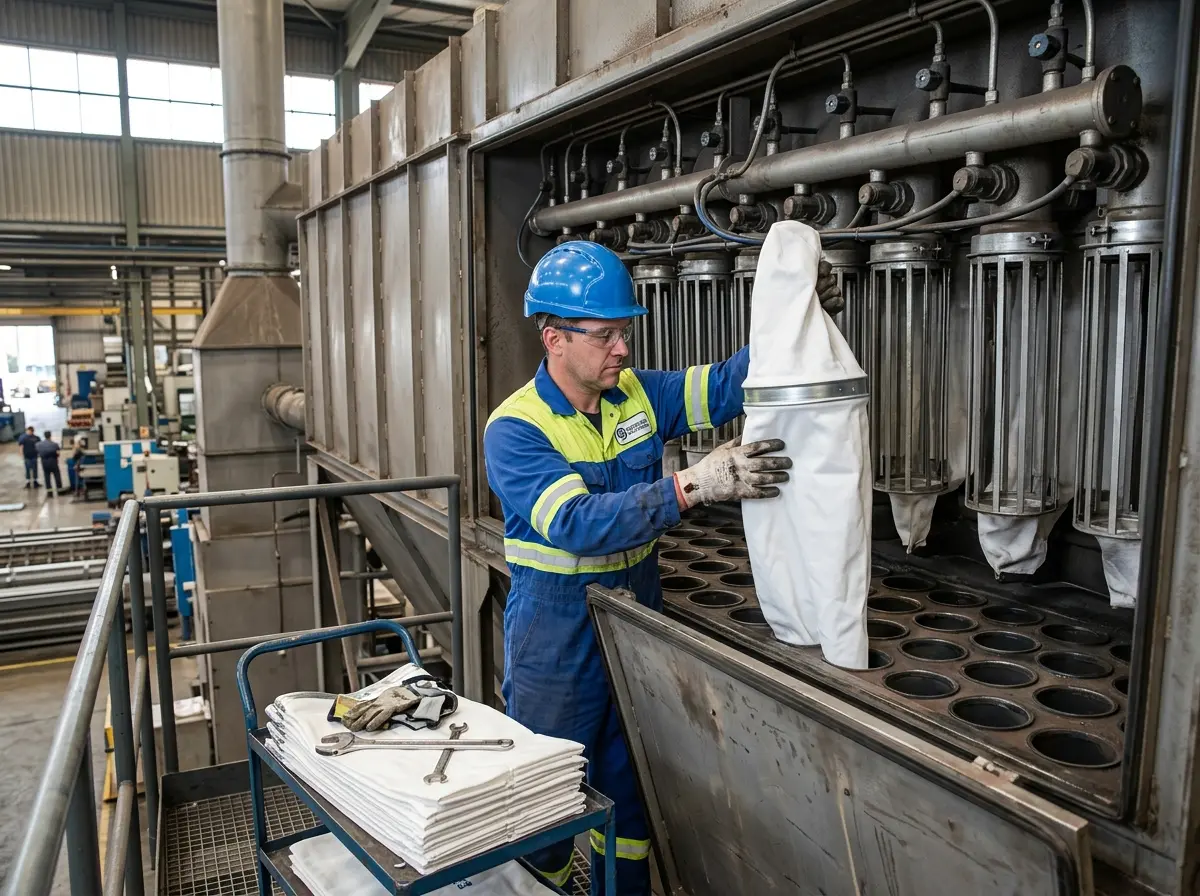
Why Baghouse Filter Replacement Matters for Your Facility
Baghouse filter replacement is one of the most important maintenance tasks in any industrial dust collection system. Done right, it keeps your air clean, your system efficient, and your facility in compliance with EPA regulations. Done wrong, it leads to costly downtime, early filter failure, and potential regulatory penalties.
Here is a quick overview of the baghouse filter replacement process:
- Identify the right time to replace – Watch for rising differential pressure, visible dust emissions, or reduced airflow.
- Select the correct filter media – Match the material (polyester, aramid, PTFE, fiberglass) to your temperature, chemical, and dust load conditions.
- Prepare for the change-out – Lock out/tag out the system, gather PPE, tools, and replacement bags and cages.
- Remove old bags and inspect – Clear dust cake, dispose of old bags, and inspect the tubesheet and cages for wear or corrosion.
- Install new filter bags – Seat snap bands correctly, align pleated bags or traditional bags per your baghouse type (pulse jet, shaker, or reverse air).
- Start up and monitor – Run a leak test, precoat if needed, and track differential pressure to confirm proper performance.
Choosing the wrong filter media, skipping inspection steps, or rushing installation are the most common causes of premature filter failure. This guide walks you through each step so you get it right the first time.
Baghouses are the particulate-control stage in many industrial air pollution control systems. In some applications, that dry collection stage is followed by wet treatment equipment to address acid gases or other contaminants before the exhaust reaches the stack. That system-level view matters because poor bag performance can affect airflow, upstream process capture, and downstream compliance equipment.
I’m Mike Eaton, Director of Marketing for Carrier Process Equipment Group, which includes Sly, a 150+ year old air pollution control company with deep expertise in baghouse design, filter selection, and aftermarket services, including baghouse filter replacement programs for complex industrial applications. In this guide, I’ll walk you through everything you need to know to replace your baghouse filters correctly and keep your system running at peak performance.
For a general background on how these systems work, the baghouse article on Wikipedia is a useful external reference alongside your equipment manual and site-specific operating procedures.
When and Why to Perform Baghouse Filter Replacement
In industrial air pollution control, a baghouse is only as good as its filters. While the heavy steel housing and the pulse-jet cleaning system are built to last for decades, the filter bags are the consumable part that directly controls particulate capture and system resistance. Regular baghouse filter replacement is not just a maintenance suggestion. It is an operating requirement for stable airflow, predictable pressure drop, and reliable emissions performance.
There are 3 reasons to replace your dust collector filter bags that every plant manager should keep in mind: maintaining system efficiency, protecting downstream equipment, and ensuring environmental compliance.
The problem is usually straightforward. As dust embeds deeper into the media and can no longer be released by cleaning pulses, the bags become blinded. The mechanism is rising differential pressure, reduced air volume, and poorer capture at hoods or pickup points. The solution is to replace the bags before the restriction causes process upset, emissions issues, or unnecessary fan energy use.
This matters even more in facilities that use a baghouse as one stage of a larger air pollution control train. For example, particulates are often removed first, then a wet scrubber or other downstream equipment handles acid gases or process vapors. If the baghouse is overloaded or leaking, the rest of the system may not perform as designed.
Furthermore, operating with compromised filters puts you at risk of violating strict EPA regulations. Modern standards like the Mercury and Air Toxics Standards (MATS), Boiler MACT, and various NESHAPs for industries like cement and power generation require nearly zero visible emissions. Even a small pinhole leak can lead to a black stack event and costly enforcement action. For regulatory background, the U.S. Environmental Protection Agency is the primary source for current federal air rules and guidance.
Signs It Is Time for Baghouse Filter Replacement
The most common question we hear is: “How do I know when they’re actually done?” You do not want to replace bags too early and waste money, but waiting too long can create a much larger maintenance event.
Why do my filter bags keep failing? Often, it is because the system was not monitored closely enough. Watch for these key indicators:
- High Differential Pressure: If your gauge consistently reads above 6 inches of water column (w.c.) even after a cleaning cycle, the bags are likely blinded.
- Visible Emissions: Any dust exiting the exhaust stack indicates a leak or bleed-through.
- Reduced Suction: If dust is escaping the hoods at your process points, the filters are likely too restricted to allow proper airflow.
- Frequent Cleaning Cycles: If your pulse-jet system is firing constantly just to maintain a steady pressure, the media is nearing the end of its life.
| Industry | Typical Filter Lifespan | Primary Wear Factor |
|---|---|---|
| Woodworking / Sawmills | 2 – 5 Years | Dust Load / Abrasion |
| Cement / Minerals | 1 – 3 Years | Abrasion / Chemical Attack |
| Power Generation (Coal) | 2 – 4 Years | Temperature / Acid Gases |
| Chemicals / Plastics | 1 – 2 Years | Moisture / Chemical Reaction |
| Food Processing | 1 – 3 Years | Moisture / Oil Content |
Selecting the Right Media for Baghouse Filter Replacement
Selecting the right material is the single most important decision in the baghouse filter replacement process. If you place a standard polyester bag in a high-temperature acidic environment, it can fail very quickly.
When selecting the correct filter media, we look at the four pillars of the application: temperature, chemistry, moisture, and abrasion.
For many standard applications, there are six fabric filters for regular temperature applications that we frequently recommend. These include:
- Polyester: The all-purpose choice. It is affordable and has good abrasion resistance, but should not be used above 275°F.
- Aramid (Nomex®): Excellent for high temperatures up to 400°F and is often used in asphalt plants and metal foundries.
- PTFE (Teflon®) Membrane: This is a laminate applied to the surface of other fabrics. It provides surface filtration, allowing dust to release more easily and protecting the base fabric from chemical attack.
- Fiberglass: Best for extreme heat up to 500°F, but very brittle. It requires careful handling and a compatible cage design.
- P84 (Polyimide): A high-performance fiber with a trilobal shape that increases surface area, making it well suited for sub-micron particulate capture.
Finishes also play a major role. A singed finish helps release dust cake. Acid-resistant or oleophobic treatments are important if your process exhaust contains chemicals or moisture that could cause sticky deposits on the bags.
Step-by-Step Guide to Replacing Industrial Filter Bags
Once you have your replacement bags and cages on-site, it is time for the actual change-out. At Sly, we provide Aftermarket Services and Replacement Parts to help facilities plan and execute this work with less risk.
Safety is paramount. Baghouses are often classified as confined spaces. Before anyone enters the housing, you must follow strict Lockout/Tagout (LOTO) procedures for the fan, rotary airlock, and cleaning controls. Any stored energy source must be isolated in accordance with your site procedures, and compressed air to the cleaning system must be bled off to prevent the valves from firing unexpectedly.
This is also where a systems mindset matters. Replacing bags is not just a fabric swap. It is a controlled maintenance activity that affects fan loading, capture velocity, hopper discharge, and any downstream treatment stage tied to the collector.
Preparing for the Change-Out
Preparation is where you save time and avoid repetitive work. Do not just order bags. Check your replacement cages as well. If a cage is bent, corroded, or has broken wires, it can quickly cut through your new filter bag.
Ensure your team has the following:
- PPE: High-efficiency respirators, eye protection, gloves, and disposable coveralls.
- Tools: Snap-band tools, hand tools appropriate for your collector design, and industrial vacuums.
- Lighting: Explosion-proof drop lights if required for the area classification.
- Replacement Inventory: Have 5-10% extra bags on hand in case of installation damage.
- Documentation: Bag layout, orientation notes, and maintenance records so the crew can confirm fit, quantity, and installation sequence.
Also verify the collector type before starting. Pulse-jet, shaker, and reverse-air units do not all use the same loading method, bag top, or support hardware. Top-load and bottom-load systems also require different handling approaches.
Removing Old Bags and Cages
The big debate is often: should I replace my filter bags or clean them? In most industrial cases, cleaning is only a temporary measure. Once the fibers are blinded, laundering often changes bag dimensions or damages the finish.
To remove the old bags:
- Pulse the system one last time with the fan off to drop as much dust cake as possible into the hopper.
- Remove the cages for top-load systems and inspect them for bowing, corrosion, or broken wires.
- Collapse the snap band at the top of the bag and remove the bag according to the collector design.
- Inspect the tubesheet carefully. Look for corrosion, wear, or pitting around the holes. If the sealing surface is damaged, the new bags may not seat correctly.
- Clean the sealing area so the new snap bands seat against clean metal.
Dispose of old bags in accordance with your facility’s waste-handling requirements and the nature of the collected dust.
Installing New Filter Bags
Installation techniques vary by baghouse type. For pulse-jet systems, you are typically dealing with snap bands, which are flexible metal rings sewn into the top of the bag.
- Alignment: Lower the bag into the tubesheet hole without twisting the fabric.
- Seating: Pop the snap band into place. The groove in the band must sit evenly and flush with the tubesheet.
- Cage Insertion: Carefully slide the cage into the bag. Do not drop it. The cage weight can damage the bag bottom if inserted too aggressively.
Post-Replacement Maintenance and Startup
The first few hours of a new filter’s life are critical. If you start a fan at full speed against brand-new clean bags, high velocity can drive fine particulate deep into the fabric and cause initial blinding.
To reduce that risk, many applications benefit from precoating. This means injecting a neutral, porous powder into the system before process dust arrives so an initial dust layer protects the fabric surface.
Once the system is running:
- Leak Testing: Perform a dye- or powder-based leak test to confirm proper seating and identify any bypass on the clean side.
- Monitor Differential Pressure: Track pressure daily in a maintenance log.
- Check Cleaning Performance: Confirm that pulse timing, valve operation, and compressed air quality support normal pressure recovery.
- Ramp Up Carefully: If possible, use a variable-frequency drive to increase airflow gradually while the bags season.
Properly maintained dust collectors are a critical part of a safe and compliant plant. In many facilities, they also protect downstream wet scrubbers or other air pollution control stages by removing particulates before gas treatment. By following these steps for baghouse filter replacement, you help the full system deliver stable airflow, better compliance performance, and longer equipment life.
Frequently Asked Questions
Q: How often should I replace my baghouse filters? A: It depends on the application, but most industrial filters last between 1 and 3 years. If your differential pressure stays high or you see dust at the stack, it’s time.
Q: Can I just wash my old bags to save money? A: We generally advise against it. Laundering can change the bag’s dimensions, damage the specialized finishes, and rarely restore the original airflow capacity.
Q: What is the benefit of pleated bags over traditional bags? A: Pleated bags offer more surface area, which allows for a lower air-to-cloth ratio. They also eliminate the need for cages, making baghouse filter replacement much faster and easier.
Q: Why is my differential pressure still high after a change-out? A: This usually points to a problem with the cleaning system (low compressed air pressure, failed pulse valves) or an undersized baghouse for the current dust load.
Q: Do I need to replace the cages every time I replace the bags? A: Not necessarily, but you must inspect them. If you see any rust, broken welds, or bending, replace them. A bad cage will ruin a new bag very quickly.
Sly, LLC has been a leader in the air pollution control industry since 1902, when we pioneered the very first cloth-type dust collector. Today, we continue that legacy by designing and manufacturing custom baghouses and wet scrubbers for the world’s most demanding industries. If you’re evaluating a multi-stage dust and gas collection system or need expert guidance on your next baghouse filter replacement, Sly’s engineers are ready to help you achieve the cleanest air possible.