

Why Industrial Facilities Rely on Wet Scrubber Systems
Wet scrubber systems are industrial air pollution control devices that use liquid (typically water) to remove harmful pollutants from exhaust gas streams. Here’s what you need to know:
How Wet Scrubbers Work:
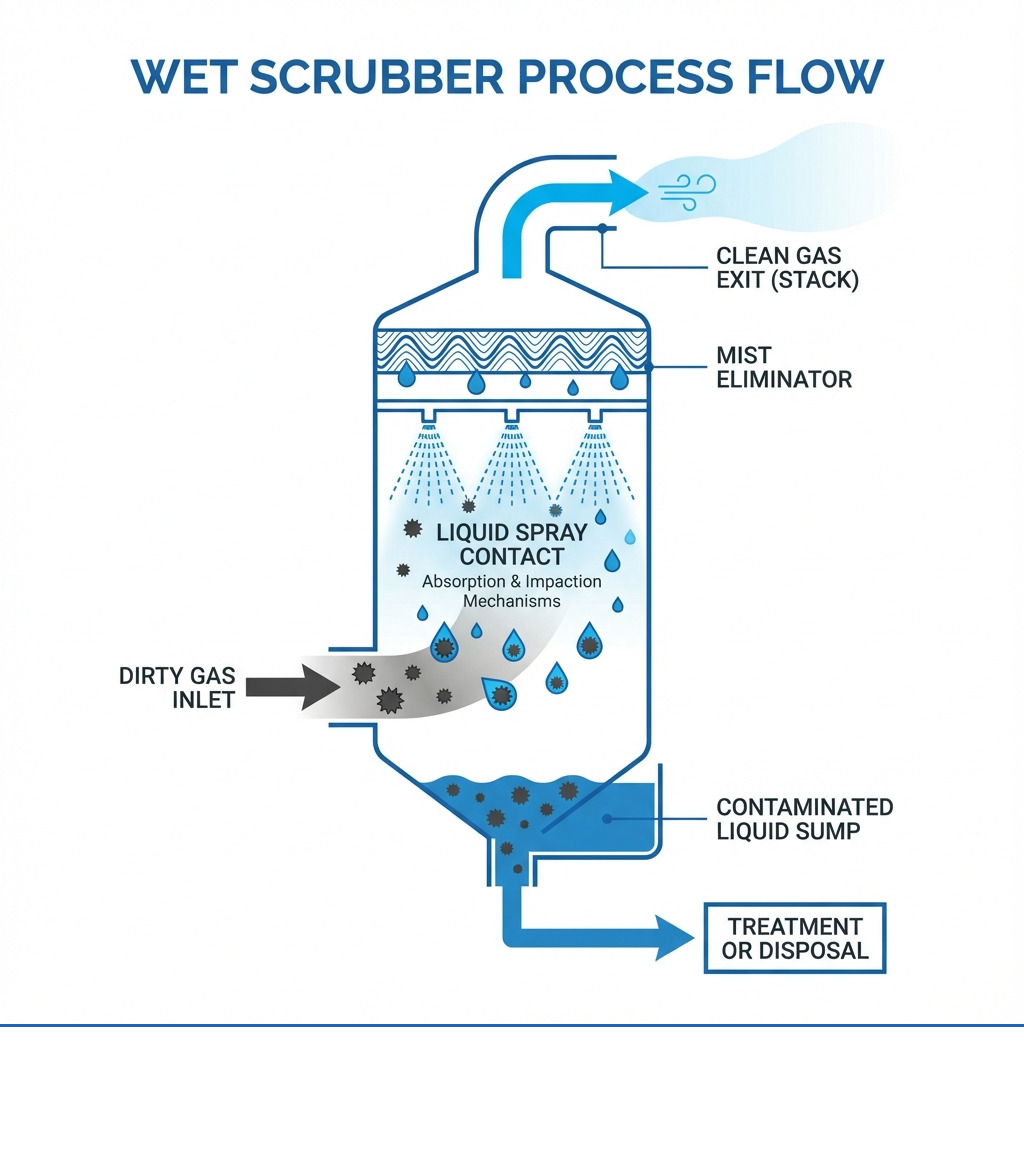
- Contaminated gas enters the scrubber vessel
- Liquid is sprayed or contacted with the polluted gas stream
- Pollutants are captured through impaction, absorption, or chemical reaction
- Clean gas exits through the stack
- Collected pollutants are removed with the liquid for disposal
Key Benefits:
- Remove both particulate matter (PM10, PM2.5) and gaseous pollutants (SO2, HCl, VOCs)
- Achieve 90-99% removal efficiency for most applications
- Handle high-temperature gas streams (over 500°F)
- Neutralize corrosive and combustible materials safely
If you’re managing an industrial facility, you know the challenges: maintaining clean air, meeting environmental regulations, and maintaining operational efficiency. Wet scrubbers offer a proven solution that has controlled industrial emissions for decades.
These systems work because they bring polluted gas into direct contact with a scrubbing liquid. The liquid captures harmful particles and absorbs soluble gases. It’s a simple principle, but the engineering behind it matters. Well-designed wet scrubbers achieve greater than 95% particulate-matter removal efficiency and over 90% gaseous-pollutant removal efficiency.
The technology has evolved significantly. Modern wet scrubbers can handle everything from sticky food residues in processing plants to corrosive acid gases in chemical manufacturing. They’re compact compared with other pollution-control technologies and can treat multiple pollutants in a single system.
This guide will walk you through how wet scrubbers work, the different types available, what pollutants they remove, and how to choose the right system for your facility.
The Fundamentals: What is a Wet Scrubber and How Does It Work?
At its core, a wet scrubber system is an air pollution control device that treats industrial exhaust gases by contacting them with a scrubbing liquid, typically water or a chemical solution. This contact enables the liquid to capture and neutralize harmful pollutants, preventing their release into the atmosphere. It’s a bit like giving your industrial exhaust a refreshing shower before it goes out into the world!
The magic happens through a process called absorption for gases and various physical mechanisms for particles. When dirty gas enters the scrubber, it meets a fine spray of liquid or passes through a liquid pool or wetted packing material. Pollutants in the gas dissolve into the liquid or are physically trapped by the liquid droplets. The cleaned gas then exits the system, and the now-contaminated liquid is collected for treatment and disposal or recirculation. For a more in-depth look, check out our article, What is a Wet Scrubber?.
Main Components of a Wet Scrubber
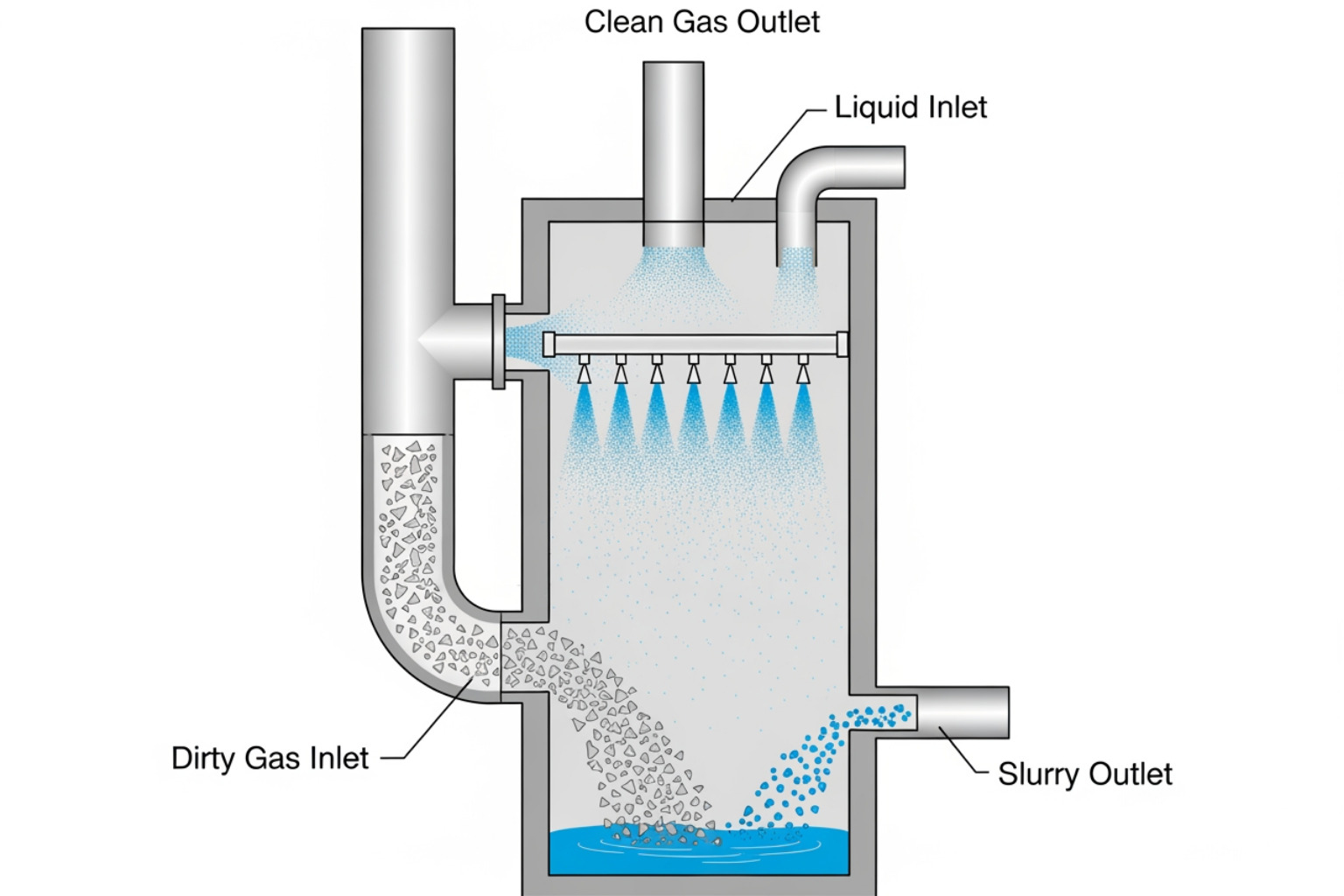
While specific designs vary, most wet scrubber systems share several key components that work in harmony to clean the air:
- Inlet Ductwork: This is where the dirty exhaust gas enters the scrubber vessel.
- Scrubbing Vessel (Chamber): The main body of the scrubber where the gas and liquid come into contact. It can be a tower, a chamber, or a specialized contact zone.
- Liquid Spray Nozzles: These create fine liquid droplets to maximize the surface area for gas-liquid contact. In some designs, liquid might flow over packing material instead.
- Packing Media (for Packed Towers): Randomly or structured arranged materials that provide a large surface area for gas-liquid contact, enhancing absorption efficiency.
- Mist Eliminator (Entrainment Separator): Located at the exit of the scrubbing vessel, this crucial component removes any liquid droplets that might have been carried over by the cleaned gas stream, ensuring only clean, dry gas exits.
- Pumps and Fans: Pumps circulate the scrubbing liquid, while large industrial fans (often induced draft fans) pull the exhaust gas through the entire system.
- Liquid Handling System: This includes a recirculation tank, chemical feed systems (if a reagent is used), and a blowdown system for removing spent scrubbing liquid.
Each component plays a vital role in the overall efficiency and effectiveness of the wet scrubber system. To see a detailed breakdown of one common type, explore The Anatomy of an Impinjet Wet Scrubber.
The Scrubbing Process Explained
The process within a wet scrubber is a carefully orchestrated sequence of events designed to maximize pollutant removal. It typically involves:
- Gas Flow: Contaminated industrial exhaust gas is drawn into the scrubber.
- Liquid Introduction: A scrubbing liquid (often water, sometimes with chemical additives) is introduced into the gas stream. This can be through sprays, bubbling, or flowing over packing material.
- Gas-Liquid Contact: This is the heart of the process. Pollutants are transferred from the gas phase to the liquid phase through several mechanisms:
- Impaction: Larger particulate matter physically collides with and is captured by liquid droplets. This is dominant for particles larger than 1.0 μm.
- Diffusion: Very small particles (sub-micron, less than 0.1 μm) move randomly due to Brownian motion and diffuse into the liquid droplets.
- Interception: Particles follow gas streamlines but, due to their size, come into contact with the liquid droplet’s surface. This is significant for particles between 0.1 and 1.0 μm.
- Chemical Reaction/Absorption: Gaseous pollutants dissolve into the scrubbing liquid. If the liquid contains a reactive chemical (e.g., an alkaline solution for acid gases), a chemical reaction occurs, neutralizing the pollutant and permanently removing it from the gas stream.
- Separation: After contact, the now-cleaned gas, carrying entrained liquid droplets, passes through a mist eliminator. This device removes the liquid droplets, preventing them from escaping with the cleaned gas.
- Liquid Recirculation/Disposal: The spent scrubbing liquid, now containing the captured pollutants, collects in a sump. It may be partially recirculated after solids settle, or a portion (blowdown) may be sent for further treatment and proper disposal to maintain scrubber efficiency.
This continuous cycle ensures that harmful substances are effectively removed from the air. For a quick reference, our Pocket Guide: Wet Scrubber Basics offers a handy overview.
A Guide to Different Types of Wet Scrubber Systems
Just as there are many different types of industrial emissions, there are various types of wet scrubber systems, each engineered to excel at specific tasks. The choice of scrubber depends on the pollutant type (particulate, gaseous, or both), the desired removal efficiency, gas flow rates, temperature, and available footprint.
While all wet scrubbers use liquid to clean gas, their internal designs and energy use can vary significantly. Some are designed as “high-energy” scrubbers for fine particulate, while others are “low-energy” for gaseous absorption. Understanding these differences is key to selecting the right solution for your air-pollution-control challenge. You can explore The 3 Most Common Types of Wet Scrubbers for a broader understanding.
High-Energy Scrubbers for Particulate Matter
When dealing with fine particulate matter, especially sub-micron particles, high-energy wet scrubbers are often the go-to solution. The most prominent example is the Venturi Wet Scrubber.
A Venturi Wet Scrubber works by accelerating the dirty gas stream to very high velocities (12,000 to 36,000 ft/min) through a constricted throat section. As the gas accelerates, scrubbing liquid is injected, shearing it into extremely fine droplets. The high-speed collisions between these tiny liquid droplets and fine particulate matter enable efficient capture. This process typically results in a significant pressure drop across the scrubber, which is why they are considered “high-energy” devices.
Venturi scrubbers are particularly effective for:
- Capturing fine dust, including PM10 and PM2.5.
- Handling sticky dusts and residues that would clog dry filters.
- Treating high-temperature gas streams.
- Removing aerosols and oil mist.
They are known for their high particulate-matter removal efficiency, often exceeding 95%. To learn more about their mechanics, dig into How Does a Venturi Scrubber Work?.
Wet Scrubbers for Gaseous Pollutants
For removing gaseous pollutants, the focus shifts from high-velocity impaction to maximizing gas-liquid contact and chemical absorption. Several types of wet scrubbers excel in this area:
- Packed Tower Wet Scrubber: These scrubbers feature a bed of specialized packing material that provides a large surface area for gas-liquid interaction. Dirty gas typically flows upward, while scrubbing liquid trickles downward over the packing, ensuring intimate countercurrent contact and efficient absorption. Packed towers are highly effective for soluble gases like SO2, HCl, and various VOCs. We offer robust Packed Tower Wet Scrubber solutions, often achieving removal efficiencies in excess of 90 percent, depending on the pollutant. You can find more technical details in the EPA Fact Sheet – Packed-Bed/Packed-Tower Wet Scrubber.
- Impingement Wet Scrubber: This design uses impingement plates or trays to generate turbulence and promote gas-liquid contact. Gas is forced through holes in the plates, bubbling through a liquid layer or impacting a wetted surface. This design is versatile and can handle both particulate and gaseous pollutants, offering excellent performance for a range of applications. Our Impinjet Wet Scrubber is a testament to this robust technology.
- Eductor Wet Scrubber: Also known as jet venturi scrubbers, these devices use the energy of a high-velocity liquid stream to entrain and scrub the dirty gas. The liquid jet creates a vacuum, drawing in the gas and mixing them vigorously, leading to effective capture of both particles and soluble gases. Eductor scrubbers are particularly useful for applications with low gas flow rates or where a fan cannot be used. Learn more about our Eductor Wet Scrubber offerings.
Specialized Designs like FRP Scrubbers
In many industrial settings, particularly in chemical plants and metal-finishing operations, the gases being treated are highly corrosive. This demands specialized construction materials that can withstand aggressive chemical attack. This is where FRP Wet Scrubbers shine.
Fiberglass Reinforced Plastic (FRP) is an ideal material for scrubber construction in corrosive environments due to its excellent chemical resistance and durability. FRP scrubbers are custom-designed to handle specific corrosive emissions, ensuring longevity and reliable performance where traditional metal scrubbers would quickly degrade. We use FRP for our Corrosive Emissions FRP Wet Scrubbers to provide robust solutions.
Industries such as metal finishing, semiconductor manufacturing, and chemical production frequently rely on FRP scrubbers to control hazardous gases, including hydrochloric acid (HCl), sulfuric acid (H2SO4), and other corrosive compounds. These systems not only protect the environment but also ensure the safety of plant personnel. For more insights into their application, read Clearing the Air: How FRP Scrubbers Keep Chemical Plants Safe from Hazardous Gases.
Performance, Pollutants, and Practical Considerations
Understanding the different types of wet scrubber systems is just the first step. To truly appreciate their value, we need to look at what they can achieve, their operational nuances, and the factors that influence their selection and cost.
The performance of a wet scrubber is critical, and we constantly strive for maximum efficiency. Well-designed wet scrubbers can achieve high removal efficiencies—often exceeding 90% for pollutants and, in some cases, even 99% for specific applications. This level of performance is crucial for meeting stringent environmental regulations and maintaining clean air. For more on this, see The Importance of Wet Scrubber Efficiency.
What Pollutants Can Wet Scrubbers Remove?
Wet scrubber systems are incredibly versatile, capable of removing a wide array of pollutants from industrial exhaust streams. This dual-action capability—handling both particles and gases—makes them a powerful tool in air pollution control.
Here’s a list of pollutants wet scrubbers can effectively remove:
- Particulate Matter (PM): This includes both coarser particles (PM10) and fine particles (PM2.5), often achieving high efficiencies for particles down to 0.5 μm with sufficient energy input. Wet scrubbers capture relatively small dust particles with large liquid droplets.
- Acid Gases: Highly soluble acid gases like Sulfur Dioxide (SO2), Hydrogen Chloride (HCl), Hydrogen Fluoride (HF), and Hydrogen Bromide (HBr) are readily absorbed and neutralized by alkaline scrubbing liquids.
- Volatile Organic Compounds (VOCs): While some VOCs are challenging to remove, many are soluble in specific scrubbing liquids or can be chemically reacted to facilitate removal.
- Odors: Many odorous compounds are gaseous and can be effectively removed through absorption and chemical reaction in a wet scrubber.
- Corrosive Gases: Beyond acid gases, wet scrubbers can neutralize other corrosive gases, protecting downstream equipment and the environment.
- Other Chemical Vapors and Aerosols: A broad range of other chemical emissions can be targeted depending on their solubility and reactivity with the chosen scrubbing liquid.
Wet scrubbers can handle gas streams containing a mixture of these pollutants, providing a comprehensive solution for many industrial processes. For more details on particulate removal, refer to What Particles Does a Wet Scrubber Remove?.
Advantages and Disadvantages of Wet Scrubber Systems
Like any technology, wet scrubber systems have their own pros and cons. We believe in providing a clear picture so you can make an informed decision for your facility.
| Advantages | Disadvantages |
|---|---|
| High Efficiency: Can achieve 90-99% removal for both particulate and gaseous pollutants. | Wastewater Disposal: Generates a wastewater stream (blowdown) that requires treatment and proper disposal, which can be costly. |
| Handles High Temperatures & Moisture: Can cool hot, humid gas streams, simplifying upstream processes and handling conditions that dry systems cannot. | Corrosion Potential: The presence of water and absorbed chemicals can lead to corrosion issues if not properly managed with appropriate materials (e.g., FRP). |
| Removes Gases & Particles Simultaneously: Unique capability to control both types of pollutants in a single system. | Handles Combustible Dusts: Safely wets combustible dusts to reduce explosion risk. |
| Compact Design: Often smaller in footprint compared to other pollution control devices like baghouses or electrostatic precipitators. | Energy Costs: Can incur significant operating costs due to power consumption by fans and pumps, especially in high-energy designs. |
| Neutralizes Corrosive Gases: Can use reactive liquids to neutralize acidic or corrosive gas components. | Freezing Potential: In cold climates, water lines and components can freeze if not properly insulated or heated. |
| Handles Combustible Dusts: Safely wets combustible dusts, reducing explosion risks. | Visible Plume: Can produce a visible steam plume, especially in cold weather, which might raise aesthetic concerns. |
| Simple Operation: Generally straightforward to operate once properly configured. | Increased Humidity: Adds moisture to the gas stream, which may require additional drying if downstream processes are sensitive to humidity. |
While there are challenges, many of these can be mitigated through proper design, material selection, and a robust maintenance program. For a more detailed comparison, check out What are the Advantages and Disadvantages of Using Wet Scrubbers?.
Monitoring, Maintenance, and Cost Factors
To ensure a wet scrubber system operates effectively and efficiently, consistent monitoring and maintenance are crucial. These factors also significantly influence the overall cost of ownership.
Monitoring Performance:
We recommend monitoring several key indicators to ensure optimal performance:
- Pressure Differential: The pressure drop across the scrubber. A change can indicate plugging, changes in gas flow, or other operational issues.
- Liquid Flow Rate: Monitoring the scrubbing liquid flow rate ensures adequate contact with the gas stream.
- pH Monitoring: For acid gas removal, maintaining the correct pH of the scrubbing liquid is critical for neutralization and preventing corrosion. This can serve as a strong indicator of removal efficiency for such pollutants.
- Scrubber Liquid Outlet Concentration: Directly measuring the pollutant concentration in the spent liquid helps assess removal efficiency.
- Gas Flow Rate and Temperature: These factors influence scrubber design and performance, and changes can impact efficiency.
The EPA provides extensive guidance on monitoring, noting that most absorbers have removal efficiencies in excess of 90 percent. Continuous monitoring helps maintain these high efficiencies and ensures compliance. You can find more details on monitoring techniques in the Monitoring by Control Technique – Wet Scrubber For Gaseous Control document.
Maintenance:
Regular maintenance is essential to prevent operational issues such as freezing, scaling, and plugging. This includes:
- Inspecting and cleaning nozzles to ensure proper spray patterns.
- Checking packing material for buildup or damage.
- Maintaining pumps and fans.
- Managing the scrubbing liquid system, including blowdown and chemical additions.
Cost Factors:
The cost of wet scrubber systems involves both initial capital investment and ongoing operating costs.
- Capital Cost: This varies widely based on factors like gas volume, pollutant type and concentration, required removal efficiency, and materials of construction. While initial costs can be substantial, they often represent a lower investment than some dry systems.
- Operating Costs: These include utilities (electricity for fans and pumps; water use), chemical reagents (if used), labor for operation and maintenance, and waste-disposal costs for spent scrubbing liquid or sludge. For example, electricity for fans can be a significant portion of operating costs.
We help our clients conduct a thorough cost-benefit analysis to determine the feasibility and economic advantages of a wet scrubber for their specific operation. To understand the financial aspects better, read How to Determine Wet Scrubber Costs for Your Next System Design.
Frequently Asked Questions about Wet Scrubbers
We often hear similar questions from industrial facility managers and engineers considering wet scrubber systems. Let’s address some of the most common ones.
What industries commonly use wet scrubbers?
Wet scrubber systems are indispensable across a broad spectrum of industries due to their versatility and effectiveness in controlling diverse pollutants. We’ve seen them deployed in many applications, helping facilities meet environmental standards and improve air quality.
Here are some of the industries that commonly rely on wet scrubbers:
- Power Generation: Especially coal-fired power plants, for flue gas desulfurization (FGD) to remove SO2.
- Chemical Manufacturing: To neutralize and remove acid gases (HCl, HF, SOx) and other corrosive or hazardous chemical vapors.
- Metal Refining and Processing: For capturing particulate matter, fumes, and acid gases from smelting, pickling, and other metal treatment processes.
- Food Processing: To control odors, sticky particulate, and VOCs from cooking, drying, and other food production activities.
- Mining: For dust control in various mining operations, particularly where the dust is combustible or wet handling is preferred.
- Pharmaceuticals: To control odors and VOCs from drug manufacturing processes, ensuring product purity and environmental compliance.
- Waste Treatment: In wastewater treatment plants and incinerators, for odor control and removal of various gaseous pollutants and particulates.
- Pulp and Paper: For controlling odors and sulfur compounds from various processes.
Our Industries page provides more examples of where our solutions make a difference.
Do wet scrubbers remove NOx emissions?
This is a frequently asked question, and it’s important to clarify: wet scrubber systems are generally not designed to directly remove nitrogen oxides (NOx) with high efficiency. NOx compounds (such as nitric oxide, NO, and nitrogen dioxide, NO2) are less soluble in water and common scrubbing liquids, making them challenging to capture via simple absorption.
However, this doesn’t mean NOx goes uncontrolled. For effective NOx removal, specialized technologies are typically employed in conjunction with wet scrubbers:
- Selective Catalytic Reduction (SCR): This technology injects ammonia or urea into the exhaust gas stream upstream of a catalyst. The catalyst facilitates a chemical reaction that converts NOx into harmless nitrogen and water.
- Selective Non-Catalytic Reduction (SNCR): Similar to SCR, SNCR injects a reagent into the exhaust gas but relies on higher temperatures (without a catalyst) to achieve NOx reduction.
While wet scrubbers may not directly target NOx, they often play a crucial role in a comprehensive air pollution control strategy. They can remove other pollutants (such as particulate matter and SO2) that could interfere with SCR/SNCR systems, producing a cleaner gas stream for optimal NOx reduction. This system integration ensures that facilities can meet all emission limits for various pollutants.
What are the key considerations when selecting a wet scrubber?
Choosing the right wet scrubber system is a critical decision that impacts both environmental compliance and operational efficiency. We always emphasize a thorough evaluation of your specific application.
Here are the key considerations we guide our clients through:
- Pollutant Characteristics: What specific pollutants (particulate type and size, gas type, solubility, reactivity) are present in your exhaust stream? Are they sticky, corrosive, or combustible?
- Gas Flow Rate: The volume of exhaust gas to be treated directly influences the scrubber’s size and design.
- Temperature and Humidity: High temperatures and high moisture content can influence material selection and require pre-cooling (quenching), but are generally well managed by wet systems.
- Required Efficiency: What are the regulatory limits for each pollutant? This dictates the necessary removal efficiency and, consequently, the scrubber design and energy input.
- Footprint and Space Constraints: Available space at your facility can determine whether a vertical packed tower, a more compact venturi, or a horizontal unit is most suitable.
- Operating Costs: Consider the ongoing costs of water, chemicals, electricity, and waste disposal.
- Maintenance Requirements: Different scrubber types have varying maintenance needs.
- Materials of Construction: For corrosive gases, materials like FRP are essential for longevity and safety.
- Waste Management: How will the collected liquid or sludge be treated and disposed of?
- Multi-Pollutant Control: If you have both particulate and gaseous pollutants, a single wet scrubber or a multi-stage system might be the most effective solution.
By carefully evaluating these factors, we can custom-design a wet scrubber system that provides reliable, no-compromise solutions for the cleanest air possible. For more guidance, our article Which Wet Scrubber is Right for My Application? offers valuable insights.
Conclusion
Wet scrubber systems are a cornerstone of modern industrial air pollution control, offering robust and versatile solutions for a wide range of emission challenges. From capturing fine particulate matter to neutralizing corrosive acid gases and managing odors, their ability to handle diverse pollutants and challenging gas stream conditions makes them invaluable.
We’ve explored how these systems work, their fundamental components, and the various types available, from high-energy Venturi scrubbers for fine particles to packed towers and FRP designs for gaseous and corrosive emissions. We’ve also highlighted their significant advantages, such as high removal efficiencies and suitability for high-temperature and moist environments, while acknowledging considerations like wastewater management and energy costs.
At Sly, LLC, we understand that every industrial application is unique. That’s why we pride ourselves on designing and manufacturing custom, high-quality wet scrubber systems that deliver reliable, no-compromise solutions. Our expertise ensures that you not only meet environmental compliance but also achieve optimal operational efficiency and air quality.
Whether you’re battling stubborn particulates, hazardous gases, or a complex mix of pollutants, we are here to help you evaluate options and implement a system that brings fresh air back to your facility.
Explore our full range of Industrial Wet Scrubbers to find how we can tailor a solution for your specific needs.