

The Fundamentals of Frac Sand Production
Frac sand processing transforms raw silica sand deposits into specialized proppants that keep underground fractures open during hydraulic fracturing operations. This industrial process is essential to oil and gas extraction—the U.S. shale industry alone consumed an estimated 112 million tons of proppant in 2022.
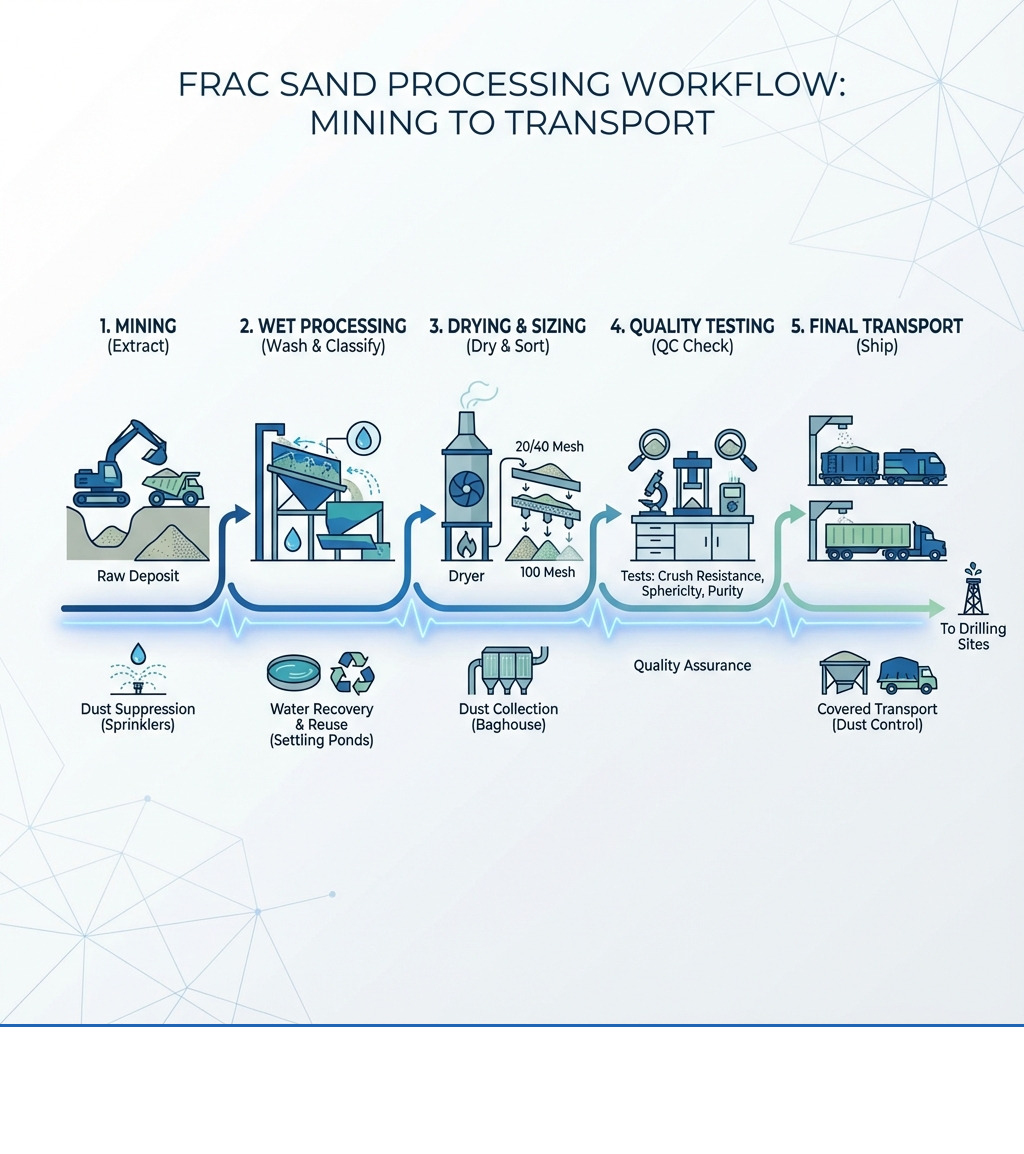
Quick Overview: What is Frac Sand Processing?
- Mining – Extract high-purity quartz sandstone from deposits (primarily in Wisconsin, Texas, and Minnesota)
- Wet Processing – Wash, scrub, and classify sand to remove clay, silt, and other impurities
- Drying & Sizing – Dry the sand and sort it into specific mesh sizes (typically 20/40, 40/70, or 100 mesh)
- Quality Control – Test for crush resistance, sphericity, and purity
- Transport – Ship finished product to drilling sites via rail or truck
The process requires careful attention to quality standards. Frac sand must have uniform particle size, high crush strength (6,000-14,000 psi), and exceptional purity to function properly as a proppant.
A single well can require up to 10,000 tons of sand. Industrial facilities process approximately 250 tons per hour, operating 24/7 to meet this demand.
The production process creates significant environmental challenges. One study found that 79% of air samples collected at frac sand sites exceeded exposure limits for silica dust. Water usage is equally intensive—one mine can demand up to 2 million gallons of water daily.
For facility managers, the biggest operational concerns are managing silica dust emissions, recovering and reusing process water, and meeting increasingly strict air quality regulations.
What is Frac Sand? Properties, Types, and Market Demand
Frac sand, also known as proppant, is far more than ordinary sand. It’s a highly specialized material that plays a critical role in unlocking hydrocarbons deep within the earth. Without it, the hydraulic fracturing (or “fracking”) process would not be nearly as effective. Let’s take a closer look at what makes this sand so unique.
Essential Properties and Attributes
When we talk about frac sand, we’re talking about a material with very specific characteristics. These aren’t just nice-to-haves; they’re essential for the sand to perform its job under immense pressure, thousands of feet underground.
First and foremost, frac sand is derived from high-purity quartz sandstone. This geological origin is key, as it provides the fundamental strength and chemical inertness required. You can learn more about the geological context in this geological overview of frac sand.
Next, we look at its physical shape: sphericity and roundness. Imagine trying to prop open a tiny crack with jagged, irregularly shaped rocks. Not very effective, right? Frac sand particles are ideally round and spherical. This shape allows them to pack efficiently, creating permeable pathways for oil and gas to flow. It also reduces friction during injection and helps the sand withstand crushing forces.
Speaking of crushing forces, high crush strength is paramount. Once injected into a fractured rock formation, the sand must withstand the immense pressure exerted by the surrounding rock. If the sand particles crush, they turn into fine dust (fines) that can clog the pathways, defeating the purpose of fracturing. Frac sand typically has a compressive strength of approximately 6,000 to 14,000 pounds per square inch (psi). This incredible resilience ensures the fractures remain open and productive.
Finally, low turbidity is a critical quality. Turbidity refers to the cloudiness of a fluid caused by suspended particles like dirt, silt, or clay. In frac sand, high turbidity indicates impurities that can reduce the sand’s effectiveness. These impurities can also block the tiny pathways that facilitate the flow of oil and gas. Therefore, processing aims to produce exceptionally clean sand with very low turbidity.
Common Types and Sizes
Just like we have different tools for different jobs, there are various types and sizes of frac sand, each suited for specific geological conditions and fracturing strategies.
Historically, “Northern White” sand from the Great Lakes Region has been highly prized for its exceptional roundness, sphericity, and high silica content. The Great Lakes Region, consisting of Illinois, Minnesota, Michigan, and southern Missouri, contributed approximately 70% of the silica sand used in America as a proppant in 2014. This naturally occurring, well-sorted sand sets a high bar for quality.
However, the industry has also seen the rise of “in-basin” sand, which refers to sand mined closer to drilling sites. While it may not possess the same pristine qualities as Northern White, its proximity significantly reduces transportation costs, making it an attractive option.
Frac sand is carefully sorted into various mesh sizes, which refer to the sieve sizes used to classify the particles. Common mesh sizes include 20/40, 30/50, 40/70, and 100 mesh. The “20/40 mesh” range, for example, means particles pass through a 20-mesh sieve but are retained on a 40-mesh sieve, typically falling within the 0.6 to 0.8 millimeters (mm) range. Different well formations and fracturing designs require different sand sizes to optimize conductivity.
Beyond natural silica sand, there are also resin-coated proppants. These are natural sand grains coated with a synthetic resin to improve their strength, prevent fines generation, and, in some cases, facilitate flowback control. While more expensive, they offer superior performance in certain demanding applications.
Factors Influencing Demand
The demand for frac sand is a dynamic beast, closely tied to the broader energy market. Several key factors cause its fluctuations.
The most obvious drivers are oil and gas prices and drilling activity. When energy prices are high, drilling becomes more profitable, leading to an increase in new wells and, consequently, a surge in demand for frac sand. Conversely, a downturn in energy markets can quickly lead to reduced drilling and a drop in sand demand.
Well completion intensity also plays a significant role. Modern fracturing techniques often involve longer horizontal wells and more fracturing stages, each requiring substantial amounts of proppant. For instance, each well may require up to 10,000 tons of sand, and industrial wells may require hundreds of tons daily. Over its lifetime, each natural gas or oil well uses millions of pounds of this sand.
The frac sand market has also experienced boom-and-bust economic cycles. Periods of rapid growth driven by high demand can lead to oversupply as new mines open, eventually causing prices to fall and some operations to become uneconomical. This volatility can create challenges for local communities that rely on the industry for jobs and revenue.
The Complete Frac Sand Processing Workflow
From raw earth to highly specialized proppant, the journey of frac sand is a multi-step process that demands precision and robust machinery.
Step 1: Mining and Extraction
The first stage of frac sand processing begins with identifying and extracting the raw material.
Site selection is a critical initial step that relies on extensive geological assessment to locate high-purity quartz sandstone deposits. These assessments ensure the quality and quantity of sand required for profitable operations.
Surface mining, typically open-pit operations, is the most common extraction method. This involves removing the “overburden”—layers of soil, rock, and vegetation that lie above the valuable sand deposit. Heavy machinery, such as industrial scrapers and tracked excavators, is used for this task. The removed topsoil and unwanted rock layers are often carefully stacked for future mine reclamation efforts.
Once the overburden is cleared, the sandstone deposit is exposed. Because the sand is actually rock, it must be pulverized. If the sandstone deposits are particularly large or consolidated, explosives may be used to break them into manageable sizes. This initial crushing step reduces the raw material to a size suitable for transport and further processing. For a deeper dive into the mining process, you can refer to insights from the frac sand mining process.
Step 2: Wet Processing
Once the raw sandstone is mined and initially crushed, it enters the wet processing stage. This is where the sand truly begins its change into a high-quality proppant. The goal here is to thoroughly wash, purify, and classify the sand.
The first major task is washing and scrubbing. The mined sand is typically mixed with water to create a slurry. This helps to remove loose dirt and initial impurities. Aggressive scrubbing, often using specialized equipment like attrition scrubbers, then takes place. These scrubbers use a “particle-on-particle attrition” principle, where sand grains are vigorously agitated against each other in a high-density slurry. This action effectively liberates stubborn clays, silts, and other deleterious materials that cling to the silica particles, significantly improving the sand’s cleanliness and reducing its turbidity.
Following scrubbing, the sand undergoes sizing and classification. This process separates sand particles into precise size ranges required by end users. Various screens and hydraulic classifiers are employed. Hydraulic classifiers work on the principle of “hindered settling,” using an upward flow of water to separate particles based on their size and density. This allows for extremely sharp and accurate separations, ensuring that only the correctly sized sand proceeds.
Finally, dewatering is a crucial step. After all the washing and scrubbing, the sand is saturated with water. The wetter the sand, the more expensive and energy-intensive it is to dry. Dewatering equipment, such as dewatering screens, removes excess moisture, typically reducing the water content to 10-15%. This prepares the sand for the next stage, minimizing fuel consumption in the subsequent drying process.
Here’s a list of key wet processing equipment commonly used:
- Hydraulic classifiers: For precise size and density separation.
- Attrition scrubbers: To aggressively clean sand by removing clays and impurities through particle-on-particle abrasion.
- Dewatering screens: To efficiently remove excess water, preparing the sand for drying.
Step 3: Drying, Final Sizing, and Transport
With the sand now clean and dewatered, it moves to the final stages of processing before it’s ready for market.
The dewatered sand proceeds to rotary dryers, large rotating cylindrical kilns that use heat to remove the remaining moisture. This step is critical because dry sand is much easier to handle, store, and transport, and its performance as a proppant relies on its dryness.
After drying, the sand undergoes final screening and sorting. This is a meticulous process in which the sand is passed through a series of vibrating screens with varying mesh sizes. This ensures that the sand is precisely classified into the specific mesh sizes (e.g., 20/40, 40/70, 100 mesh) demanded by the oil and gas industry. Any oversized or undersized particles are removed, ensuring a consistent, high-quality product.
Once sorted, the finished frac sand is typically moved to large stockpiles or directly into storage silos, awaiting transportation.
Transportation logistics are a significant part of the frac sand processing chain. The sand is typically loaded onto railcars or specialized trucks for delivery to well sites across the country. The efficiency of this “last mile” logistics can have a substantial impact on overall costs and environmental footprint.
Quality Assurance and Regulatory Compliance
Ensuring frac sand quality and adhering to environmental regulations are two sides of the same coin in this industry. Both are non-negotiable for responsible and successful operations.
Quality Control in Frac Sand Processing
Quality control isn’t just a suggestion in frac sand production; it’s a stringent requirement. The performance of a well can hinge on the quality of the proppant used.
Industry standards, such as those set by the American Petroleum Institute (API RP 19C), provide the benchmarks we strive to meet. These standards cover a range of critical properties.
One of the fundamental tests is sieve analysis. This involves passing a sample of sand through a series of progressively finer sieves to determine its exact particle size distribution. This is how we ensure the sand meets specific mesh size requirements (e.g., 20/40, 40/70).
Crush resistance testing is equally vital. Samples of sand are subjected to high pressures to simulate downhole conditions, and the amount of fines generated is measured. This test confirms the sand’s ability to withstand compressive forces without degrading.
Turbidity and solubility tests are performed to assess the purity of the sand. Turbidity tests measure the amount of suspended solids, while acid solubility tests identify non-silica pollutants. Contaminant percentages over 3% in acid solubility tests are typically not considered within industry specifications.
Beyond basic measurements, advanced computer analysis is often used to get detailed insights into particle shape, sphericity, and roundness. This ensures that the sand grains have the optimal physical characteristics to maintain fracture conductivity.
Navigating the Regulatory Landscape
The frac sand processing industry operates under a complex web of regulatory requirements designed to protect both the environment and local communities.
The permitting process is extensive and involves various federal, state, and local agencies. These permits cover air quality, water use, wastewater discharge, and land use. For instance, state-level departments of natural resources often oversee industrial sand mining and require facilities to follow comprehensive regulations. While specific regulations vary by state, many share common goals. For example, the Minnesota DNR provides information on silica sand regulations that illustrate the type of oversight common in regions with frac sand operations. Similarly, the Wisconsin nonmetallic mining code (NR 135) outlines reclamation requirements, demonstrating how states implement rules for environmental protection.
There’s often a division of labor between state and local oversight. State agencies typically handle permits for air emissions, water withdrawals, and wastewater discharges, focusing on broader environmental protections. Local governments, on the other hand, often manage zoning, noise ordinances, traffic impacts, and reclamation plans, addressing immediate community concerns. This multi-layered approach ensures comprehensive regulation.
Environmental impact assessments (EIAs) are a crucial part of the process. Before a mine or processing facility can be established, a thorough EIA evaluates potential environmental repercussions, from changes in hydrology to impacts on air quality and wildlife habitats. These assessments inform decisions and help shape mitigation strategies to minimize the environmental footprint.
Managing the Environmental Footprint of Frac Sand Operations
The environmental implications of frac sand processing are significant, and responsible operations must prioritize effective management strategies. At Sly, LLC, we understand these challenges and work to provide solutions that help facilities minimize their impact.
Water Management and Tailings Disposal
Water is an indispensable resource in frac sand processing, primarily for washing and classification. This leads to high water usage; one mine, for example, can demand up to 2 million gallons of water a day. Managing this water efficiently and responsibly is paramount.
After the wet processing stages, the wastewater contains fine particles of clay, silt, and sand, collectively known as tailings. Traditionally, these tailings were directed to large settling ponds where solids slowly settled out, and the water evaporated or was discharged. While effective, settling ponds require significant land area and can pose environmental risks.
Modern facilities increasingly employ advanced technologies to improve water management. Thickeners are widely used to concentrate the waste slurry. By adding flocculants, fine solids agglomerate and settle more quickly, allowing clean water to be recovered from the top. In fact, around 90% of process water can be recovered for reuse with a thickener, significantly reducing fresh water demand.
For the concentrated solid waste from thickeners, filter presses are often used. These machines further dewater the slurry, producing a solid “filter cake” that is much easier to handle and dispose of, or even repurpose for mine reclamation, reducing the need for large, permanent settling ponds.
Managing Dust in Frac Sand Processing
Perhaps one of the most critical environmental and occupational health concerns in frac sand processing is the generation of crystalline silica dust. This fine dust, if inhaled, is a known carcinogen that can cause serious lung diseases such as silicosis. In one study, 79 percent of air samples at frac sand sites exceeded the exposure limit for silica dust, and a third were so high that most respirators wouldn’t be able to remove it from the air. The Occupational Safety and Health Administration (OSHA) provides extensive information on silica dust and its hazards.
Fugitive dust emissions can occur at various points in the process: mining, crushing, screening, drying, and transferring sand. These emissions not only pose a health risk to workers but can also impact air quality in surrounding communities.
This is where our expertise at Sly, LLC comes into play. We specialize in designing and manufacturing custom, high-quality industrial air pollution control systems. For frac sand operations, our solutions are vital. Baghouse dust collectors are highly effective at capturing fine particulate matter, including crystalline silica. These systems draw dust-laden air into the collector, trap particles on the fabric filters, and release clean air into the atmosphere. We also offer industrial wet scrubbers, which can be particularly effective in applications where dust is moist or sticky, or where specific gas contaminants are present. By implementing robust dust collection systems, facilities can significantly reduce health risks and comply with air quality regulations, ensuring a cleaner, safer operating environment.
Innovations in Sustainable Processing
The industry is continuously evolving, with a strong push towards more sustainable and efficient practices.
One significant innovation is wet sand delivery. Traditionally, frac sand is dried completely before transport. However, wet sand processing, when combined with proximity wet sand mines, can reduce operational emissions in the last mile by an average of ninety percent. This approach eliminates the energy-intensive drying step before transport, reducing fuel consumption and associated greenhouse gas emissions.
Proximity mining, locating mines closer to the oil and gas fields they serve, also contributes to sustainability. This reduces the distance sand needs to be transported, cutting down on fuel use, traffic, and transportation-related emissions.
Finally, comprehensive land reclamation plans are an integral part of modern frac sand operations. These plans, often a prerequisite for permitting, outline how the land will be restored to its pre-mining condition or to a beneficial post-mining use. This includes backfilling excavated areas, contouring the land, replacing topsoil, and replanting native vegetation, ensuring the long-term ecological health of the site.
Frequently Asked Questions about Frac Sand Production
We often hear questions about the specifics of frac sand production. Here are some of the most common ones:
How much sand is used in a single fracking well?
The amount of sand used in a single fracking well is truly staggering. Each well can require as much as 10,000 tons, or millions of pounds, of sand in its lifetime. To give you an idea of the scale, industrial wells can demand hundreds of tons of sand daily. This massive consumption underscores why frac sand processing facilities operate around the clock to meet demand.
What are the main health risks for workers at frac sand facilities?
The primary health risk for workers at frac sand facilities is exposure to respirable crystalline silica dust. Inhaling this fine dust can lead to severe and irreversible lung diseases, including silicosis, and it is also classified as a known human carcinogen that can cause lung cancer. The numbers are sobering: in one study, 79 percent of air samples at frac sand sites exceeded the exposure limit for silica dust, and a third were so high that most respirators wouldn’t be able to remove them from the air. This highlights the critical need for effective dust control measures, such as industrial dust collectors and wet scrubbers, to protect worker health.
Why is the Midwest a major source of frac sand?
The Midwest, particularly the Great Lakes Region, has historically been a major source of frac sand due to its unique geological formations. This region is home to vast deposits of high-purity quartz sandstone with ideal characteristics for frac sand: excellent sphericity, roundness, and high crush strength. These natural qualities make the sand highly effective as a proppant in hydraulic fracturing. While other regions have developed in-basin sand sources, the Midwest’s geological endowment initially made it a dominant supplier, contributing approximately 70% of the silica sand used in America as a proppant in 2014.
Conclusion
The journey of frac sand, from raw earth to a critical component in energy extraction, is a testament to sophisticated industrial processing. We’ve explored how frac sand processing involves meticulous steps from mining and wet processing to drying, sizing, and rigorous quality control. The importance of quality and consistency cannot be overstated, as the performance of a multi-million-dollar well hinges on the integrity of these tiny sand grains.
However, this vital industry also carries significant environmental responsibilities. Effective water management, innovative tailings disposal, and robust land reclamation plans are essential for sustainable operations. Above all, the critical role of air quality management, particularly in controlling crystalline silica dust, is a paramount concern for worker safety and community health.
At Sly, LLC, we pride ourselves on delivering reliable, no-compromise solutions for the cleanest air possible. Our expertise in industrial dust collection, including advanced baghouses and wet scrubbers, helps frac sand facilities meet stringent air quality standards and protect their most valuable asset: their people.
Ready to ensure your operations are as clean and efficient as possible? Explore our dust control solutions for the Mining & Minerals industry today.