

Why Acid Gas Control Matters for Your Facility
Acid gas control is the process of removing harmful acidic compounds—like sulfur dioxide (SO2), hydrogen chloride (HCl), hydrogen sulfide (H2S), and hydrogen fluoride (HF)—from industrial exhaust streams before they reach the atmosphere. These gases form when fuels containing sulfur, chlorine, or other elements are burned or processed, and they can cause serious environmental damage, health problems, and equipment corrosion.
Quick Overview:
- Common Acid Gases: SO2, HCl, H2S, HF, and NOx
- Primary Control Methods: Wet scrubbers (90-99% removal), dry sorbent injection (50-80% removal), and circulating dry scrubbers (>95% removal)
- Key Industries: Power generation, cement, pulp and paper, metals, waste incineration, and chemical processing
- Main Benefits: Meet environmental regulations, protect public health, prevent acid rain, and avoid equipment corrosion
If you manage an industrial facility, you know that regulatory compliance isn’t optional. The EPA’s Clean Air Act sets strict limits on acid gas emissions. Failing to meet these standards can result in costly fines, forced shutdowns, and damage to your company’s reputation.
But compliance is just the starting point. Acid gases are corrosive. They damage your equipment, shorten its lifespan, and drive up maintenance costs. They also pose real health risks to your workers and the surrounding community. When released into the atmosphere, these gases contribute to acid rain, which harms ecosystems, water supplies, and infrastructure.
The good news? Proven technologies exist to control acid gases effectively. The challenge is choosing the right system for your specific process conditions, removal efficiency requirements, and budget. This guide walks you through everything you need to know—from understanding what acid gases are and why they’re dangerous, to comparing wet scrubbers, dry sorbent injection, and circulating dry scrubbers, to selecting the best solution for your facility.
Understanding Acid Gases and Why Control is Crucial
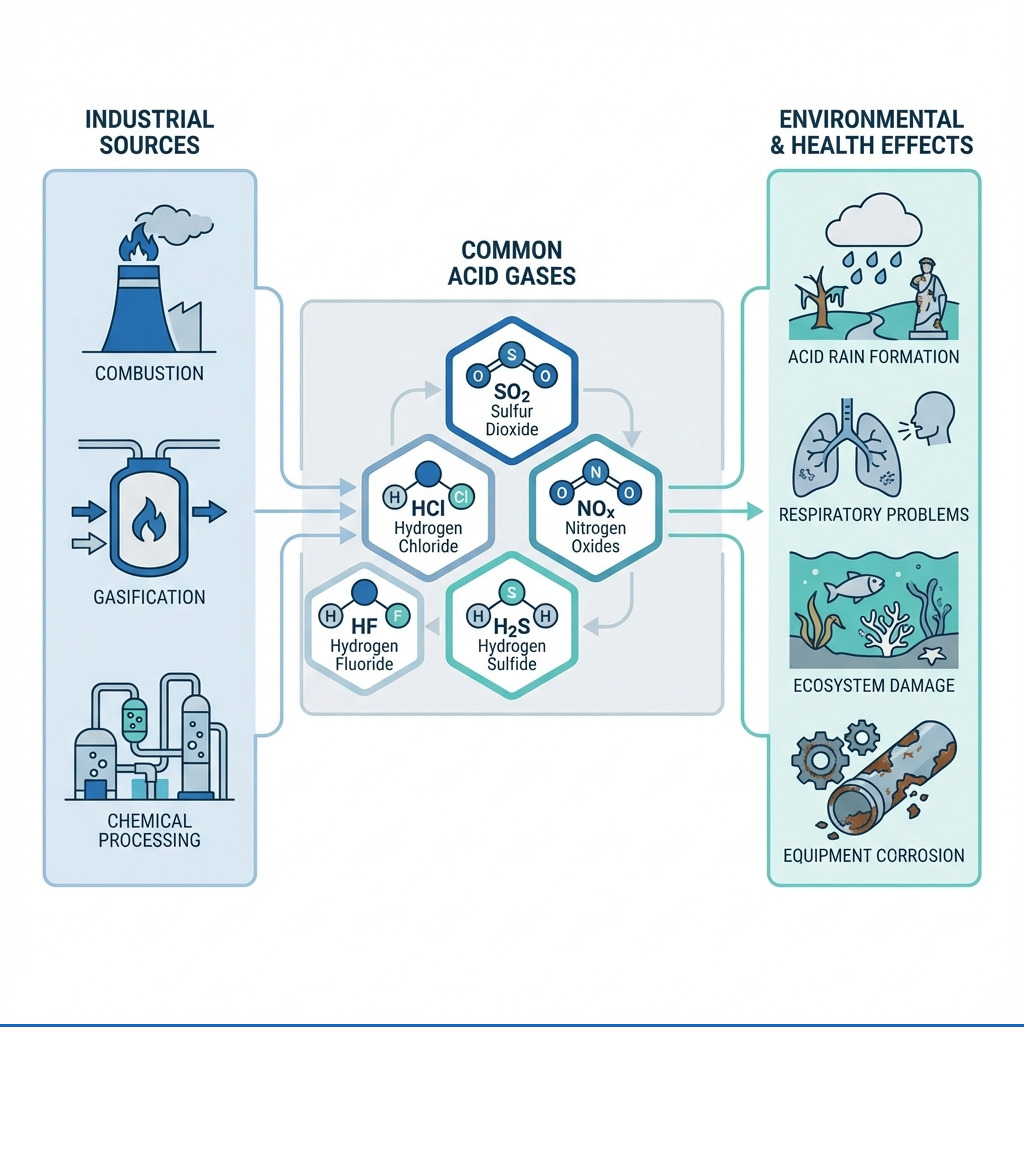
Acid gases are a group of chemical compounds that, when dissolved in water, form acidic solutions. In industrial settings, they’re typically found in exhaust streams from processes that involve combustion, gasification, and various chemical reactions. The most common culprits we encounter are:
- Sulfur Oxides (SOx): Primarily sulfur dioxide (SO2) and sulfur trioxide (SO3), often produced from burning fossil fuels like coal and oil, which contain sulfur. SO2 is a major contributor to acid rain.
- Hydrogen Chloride (HCl): A highly corrosive gas typically generated from the combustion of chlorine-containing materials, such as certain wastes or biomass.
- Hydrogen Sulfide (H2S): A highly toxic gas with a characteristic “rotten egg” smell, often found in natural gas processing, petroleum refining, and gasification processes. Its combustion products include SO2.
- Hydrogen Fluoride (HF): A highly corrosive and toxic gas, often emitted from aluminum production, phosphate fertilizer manufacturing, and ceramic operations.
- Oxides of Nitrogen (NOx): While not always strictly “acid gases” in the same chemical sense as the others, NOx compounds (like NO and NO2) contribute to acid rain and smog and are often controlled alongside other acidic pollutants.
Industrial Sources of Acid Gases
These problematic gases don’t just appear out of nowhere. They are byproducts of many essential industrial operations:
- Combustion: Power plants, industrial boilers, incinerators, and furnaces that burn coal, oil, natural gas, biomass, or waste are significant sources of SOx, NOx, and HCl.
- Gasification: In processes that convert carbonaceous materials into syngas (synthesis gas), hydrogen sulfide (H2S), carbonyl sulfide (COS), and carbon dioxide (CO2) are the main acid gases produced.
- Chemical Processing: Industries involved in chemical manufacturing, metals finishing, etching, and various other processes can emit a range of specific acid gases, including nitric acid (HNO3) mist, phosphoric acid (H3PO4) mist, and chlorine (Cl2).
The Environmental and Health Impact
The control of these emissions isn’t just about ticking a box; it’s about protecting our planet and our health.
- Environmental Impact: When released into the atmosphere, SOx and NOx react with water, oxygen, and other chemicals to form sulfuric and nitric acids. These fall back to Earth as “acid rain,” damaging forests, acidifying lakes and streams, corroding buildings and infrastructure, and harming aquatic life. Beyond acid rain, these gases contribute to smog and particulate matter formation. For more details on these benefits, see our article on the environmental benefits of scrubbers.
- Health Risks: Exposure to acid gases can cause severe respiratory problems, eye irritation, and other health issues for workers and nearby communities. H2S, in particular, is highly toxic and can be lethal even at low concentrations.
- Equipment Corrosion: Acid gases are notoriously corrosive. They can rapidly degrade industrial equipment, leading to costly repairs, increased downtime, and reduced operational lifespan.
Regulatory Drivers
In the United States, regulations like the Clean Air Act, enforced by the Environmental Protection Agency (EPA), set stringent limits on the emission of acid gases. These regulations drive the need for effective acid gas control solutions across various industries. For instance, integrated gasification combined cycle (IGCC) applications must reduce sulfur content in syngas to less than 30 parts per million by volume (ppmv) to meet stack gas emission targets of less than 4 ppmv SO2. These benchmarks continually evolve, requiring industries to adopt robust and efficient control technologies. You can dig deeper into the technical aspects of acid gas removal in this authoritative report on acid gas removal.
Wet Scrubbing: The High-Efficiency Solution for Acid Gas
When it comes to achieving high removal efficiencies for acid gases, wet scrubbers often lead the pack. These systems use a liquid absorbent or slurry to capture pollutants, offering a robust solution for many industrial applications.
At its core, wet scrubbing relies on the principle of absorption and chemical neutralization. Exhaust gas enters the scrubber and is brought into intimate contact with a scrubbing liquid. This liquid, often water with added reagents such as caustic (sodium hydroxide) or a lime slurry, absorbs the acid gases. The acid gases then react chemically with the reagents in the liquid, neutralizing them into harmless salts.
Wet Flue Gas Desulfurization (FGD) systems, a common type of wet scrubber, can achieve impressive removal efficiencies, often reaching 90-98% for SO2, with newer designs pushing towards 99%. For HCl, removal efficiencies can exceed 95%. This makes them a go-to solution for stringent emission limits. If you’re curious about the basics, we’ve got you covered with What is a Wet Scrubber? and an overview of The 3 Most Common Types of Wet Scrubbers.
Key Components and Types
Wet scrubbers come in various configurations, each designed to optimize gas-liquid contact for specific applications:
- Packed Towers: These are among the most common types of wet scrubbers. Exhaust gas flows upward through a tower packed with specialized media (like rings or saddles), while the scrubbing liquid flows downward, creating a vast surface area for gas-liquid contact. Our Packed Tower Wet Scrubber solutions are designed for maximum absorption.
- Impinjet Wet Scrubbers: These designs use impingement baffles to create turbulence and promote excellent gas-liquid contact, making them highly effective for both gas and particulate removal. Explore our Impinjet Wet Scrubber for more details, and watch The Anatomy of an Impinjet Wet Scrubber to see it in action.
- Venturi Wet Scrubbers: Known for their ability to handle high particulate loads, as well as gases, Venturi scrubbers accelerate the gas stream through a constricted throat, where it mixes vigorously with the scrubbing liquid. Check out our Venturi Wet Scrubber for robust solutions.
- Mist Eliminators: Crucial for all wet scrubbers, these components are located at the scrubber’s exhaust to remove any scrubbing liquid droplets entrained in the cleaned gas stream, preventing carryover and potential corrosion of downstream equipment.
- Scrubbing Liquid System: This includes tanks, pumps, and nozzles for preparing and distributing the scrubbing liquid, ensuring a continuous supply of fresh reagent to neutralize the acid gases.
Advantages and Limitations
Like any technology, wet scrubbers have their strengths and weaknesses:
Advantages:
- High Removal Efficiency: As mentioned, they excel at removing acid gases, often achieving 99% or more for SO2 and HCl.
- Particulate Removal: Many wet scrubber designs, particularly Venturi and Impinjet types, are highly effective at removing particulate matter, as discussed in What Particles Does a Wet Scrubber Remove?.
- Handles High Temperatures: Wet scrubbers can often cool hot gas streams, making them suitable for processes with high-temperature exhaust.
- Corrosion Resistance: With proper material selection, such as Fiberglass Reinforced Plastic (FRP), wet scrubbers can offer excellent corrosion resistance and longevity, even in highly acidic environments. Our FRP Wet Scrubbers: Corrosion Resistance and Longevity for Emissions Control details this benefit.
Limitations:
- Wastewater Generation: A significant drawback is the production of wastewater, which requires further treatment and disposal in compliance with environmental regulations.
- Corrosion Potential: Despite material advances, corrosion remains a principal operating issue if not properly managed, due to the acidic nature of the contaminant gases.
- Plume Visibility: Wet scrubbers can sometimes produce a visible steam plume from the stack, although mist eliminators and reheat can mitigate this.
For a balanced view, we invite you to read What are the Advantages and Disadvantages of Using Wet Scrubbers?.
Key Industries and Applications
All these technologies play vital roles in various sectors:
- Power Generation: Coal-fired power plants heavily rely on FGD systems (both wet and dry) for SO2 control.
- Cement Industry: CDS systems are commonly used in cement kilns.
- Pulp and Paper Mills: Acid gas control is crucial for managing emissions. Check out our insights on Enhancing Environmental Sustainability in Pulp and Paper Mills with FRP Scrubbers.
- Metals (Ferrous and non-Ferrous): Metal processing facilities often produce acid gases that require control.
- Incineration: Waste-to-energy plants and municipal/hazardous waste incinerators use various scrubbers to handle a complex mix of acid gases and particulates.
- Chemical Processes: Manufacturing facilities across the chemical industry need custom solutions for specific acid gases, such as HCl, HF, and sulfuric acid mist.
- Other: Biomass-to-energy, lime production, mining, oil and petrochemical applications, and even wastewater treatment plants all have unique acid gas control needs. For example, wet scrubbers can be an integral component of the Mercury Gas Removal system in Cement Kiln Exhausts.
Key Factors in System Design and Cost for Acid Gas Control
When designing and costing an acid gas control system, several factors go beyond just the technology type:
- Boiler Heat Input: The thermal capacity of the industrial unit directly influences the volume of flue gas to be treated and, consequently, the size and cost of the control system.
- Capacity Factor: How often the unit operates affects annual operating costs, especially for reagents and utilities.
- Site Elevation: Believe it or not, elevation can impact design. Higher elevations mean lower atmospheric pressure, which affects gas density and fan power requirements.
- Retrofit Challenges: Installing a new system in an existing facility can be more complex and costly than designing for a new build, due to space constraints and integration with existing infrastructure.
- Reagent Costs: The price of sorbents (like limestone at $28/ton or lime at $75/ton, based on 2016 data) is a significant ongoing operational expense.
These factors are crucial for accurate budgeting and system optimization. Our guide on How to Determine Wet Scrubber Costs for Your Next System Design provides further insights.
Frequently Asked Questions about Acid Gas Control
We understand that acid gas control can be a complex topic, so let’s answer some of the most common questions we hear.
What are the most common acid gases from industrial processes?
The primary acid gases we typically address from industrial processes include:
- Sulfur Dioxide (SO2) and Sulfur Trioxide (SO3), commonly from combustion.
- Hydrogen Chloride (HCl), often from waste incineration or biomass burning.
- Hydrogen Sulfide (H2S), prevalent in natural gas processing and gasification.
- Hydrogen Fluoride (HF), from specific manufacturing processes.
- And while not strictly an acid gas in the same way, Oxides of Nitrogen (NOx) are often controlled due to their contribution to acid rain.
Can a single system remove both particulates and acid gases?
Absolutely! Acid gas control systems are designed to handle both gaseous pollutants and particulate matter (PM).
- Wet Scrubbers: Many wet scrubber designs, such as Venturi and Impinjet scrubbers, are highly effective at simultaneously capturing both acid gases and fine particulates from the gas stream. The liquid spray and turbulent mixing can efficiently trap both.
What is the main difference between a wet and dry scrubber?
The fundamental difference lies in how they interact with the gas stream and handle waste:
- Wet Scrubbers use a liquid solution (typically water with chemical reagents) to absorb and neutralize acid gases. The gas stream is saturated with moisture, and the pollutants are captured in the liquid, resulting in a wet slurry or wastewater byproduct. Wet scrubbers typically offer very high removal efficiencies and can cool hot gas streams.
- Dry Scrubbers generally produce a dry solid byproduct, which can simplify disposal. While wet scrubbers often achieve higher removal efficiencies, dry scrubbers are generally less expensive, take up less space, and have lower operating costs.
Conclusion
Navigating acid gas control can feel like a maze, but understanding the basics of these powerful technologies empowers you to make informed decisions for your facility. We’ve seen that acid gases pose serious threats to our environment, our health, and your equipment, making effective control not just a regulatory mandate but a responsible operational imperative.
From the high-efficiency, multi-pollutant removal capabilities of wet scrubbers to the simpler, dry-waste handling, there’s a solution custom-made for nearly every industrial challenge. The key is to match the right technology to your specific process conditions, emission targets, and budget constraints, carefully considering factors like capital cost, operating expenses, and byproduct management.
At Sly, LLC, we’ve been pioneers in industrial air pollution control since 1902, designing and manufacturing custom, high-quality systems like our robust wet scrubbers and efficient baghouses. We believe in delivering reliable, no-compromise solutions for the cleanest air possible. Choosing the right partner with extensive experience and a commitment to understanding your unique needs is paramount.
Don’t let acid gases get the best of your operations or the environment. Take control with a custom-engineered solution that delivers both compliance and peace of mind. We invite you to Explore our Packed Tower Wet Scrubber solutions for your application or contact us to discuss your specific acid gas control challenges.