

Why Rare Earth and Critical Mineral Dust Control Matters More Than Ever
Rare Earth & Critical Mineral Dust Control is essential for protecting workers, meeting environmental regulations, and maintaining operational efficiency in mining and processing facilities. Here’s what you need to implement effective dust control:
Core Dust Control Strategies:
- Engineer controls at the source – Install local exhaust ventilation, capture hoods, and wet suppression systems at dust generation points
- Select appropriate collection equipment – Choose between baghouse dust collectors for dry applications or wet scrubbers for combustible or sticky dusts
- Establish monitoring systems – Track differential pressure, airflow, and emissions to maintain optimal performance
- Implement proactive maintenance – Schedule regular filter inspections, valve checks, and system integrity reviews
- Train workers and enforce protocols – Maintain housekeeping standards and ensure proper PPE usage
The global demand for rare earth elements and critical minerals like lithium, cobalt, and neodymium is surging. As facilities ramp up extraction and processing operations, they’re generating hazardous dust that poses serious health risks and regulatory challenges.
Unlike ordinary industrial dust, rare earth and critical mineral particulates can contain radioactive elements like thorium and uranium. Some materials have pyrophoric properties, meaning they can spontaneously ignite. The ultra-fine particles (PM2.5) penetrate deep into workers’ lungs, causing respiratory illnesses and long-term health problems.
Without proper controls, you’re facing:
- Worker health hazards and potential compensation claims
- Environmental contamination of soil, water, and air
- Equipment failures and costly downtime
- Product cross-contamination affecting quality
- Fire and explosion risks
- Steep fines from OSHA, EPA, and MSHA violations
This guide walks you through practical, proven strategies for implementing dust control systems that keep your facility clean, compliant, and productive.
Why Effective Dust Control is Non-Negotiable
In rare earth and critical mineral processing, dust isn’t just a nuisance; it’s a formidable adversary. Ignoring its presence can lead to a cascade of problems, impacting everything from the health of our team to the bottom line of our operations. We’ve seen the critical importance of robust Rare Earth & Critical Mineral Dust Control measures.
First and foremost, there are the health hazards. Mineral dust, especially the fine particulate matter generated during the processing of rare earth and critical minerals, can be incredibly insidious. Exposure can lead to serious and often irreversible respiratory illnesses. For instance, crystalline silica dust, commonly found in many mineral operations, is a known culprit behind silicosis, a debilitating lung disease. Beyond silicosis, workers can face heavy metal toxicity and other respiratory ailments, leading to long-term health issues and potential worker compensation claims. Our commitment to our workforce means ensuring the cleanest air possible. You can find more scientific research on silica dust hazards directly from OSHA.
Then, we consider the environmental impact. Uncontrolled dust doesn’t respect facility boundaries. It escapes into the atmosphere, leading to air quality degradation. It settles on surrounding land, causing soil pollution, and can even find its way into water sources, contributing to water pollution. As an industry, we have a responsibility to minimize our environmental footprint, and adhering to strict air quality standards is a crucial part of that commitment.
Finally, there are the operational risks. Dust can be surprisingly destructive to machinery. Fine particles can infiltrate sensitive equipment, causing premature wear, electrical shorts, and costly breakdowns, leading to significant production downtime. Dust can also lead to product cross-contamination, compromising the quality and purity of our valuable rare earth and critical mineral outputs. In some cases, specific mineral dusts possess pyrophoric properties or are combustible, presenting a serious fire and explosion risk if not properly managed.
Understanding the Unique Risks of REE & Critical Mineral Dust
What makes dust from rare earth elements (REEs) and critical minerals particularly challenging? It’s their unique composition and properties. Unlike many common industrial dusts, REE and critical mineral dust can harbor additional, more severe risks.
Some rare earth minerals, for example, naturally contain trace amounts of radioactive elements such as thorium and uranium. When these minerals are crushed, ground, and processed, these radioactive particles can become airborne. Inhaling or ingesting them poses a long-term radiation exposure risk to workers.
Furthermore, certain critical minerals can exhibit pyrophoric properties, meaning they can spontaneously ignite when exposed to air. Others are highly chemically reactive. These characteristics demand specialized handling and dust control strategies that go beyond conventional methods to prevent fires, explosions, and hazardous chemical reactions.
The sheer fineness of the particulate matter (PM2.5 – particles 2.5 micrometers or less in diameter) generated during processing is another significant concern. These ultra-fine particles are easily inhaled and can penetrate deep into the lungs, where they can cause more severe health effects than larger dust particles. Protecting our team from these microscopic threats is paramount.
Regulatory Compliance and Financial Implications
Operating a mining or processing facility in the United States means navigating a complex web of regulations designed to protect workers and the environment. Agencies like the Occupational Safety and Health Administration (OSHA), the Environmental Protection Agency (EPA), and the Mine Safety and Health Administration (MSHA) set stringent standards for air quality and dust control.
Non-compliance with these regulations isn’t just a hypothetical risk; it carries very real and substantial financial penalties. Fines can quickly accumulate, but the costs don’t stop there. Regulatory violations can lead to mandated production downtime while issues are rectified, resulting in lost product and revenue. Beyond fines, facilities can face increased worker compensation claims due to dust-related illnesses, legal fees, and damage to their reputation. Investing in effective Rare Earth & Critical Mineral Dust Control isn’t just about doing the right thing; it’s a smart business decision that protects our financial stability and ensures our long-term viability. We believe in proactive compliance to avoid these costly pitfalls.
A Step-by-Step Guide to Implementing Dust Control
Establishing a robust dust control program in a rare earth or critical mineral processing facility requires a systematic approach. It’s not about quick fixes but about understanding your specific challenges and implementing custom solutions. We’ve developed a practical framework to guide you.
Step 1: Assess Your Dust Generation Points
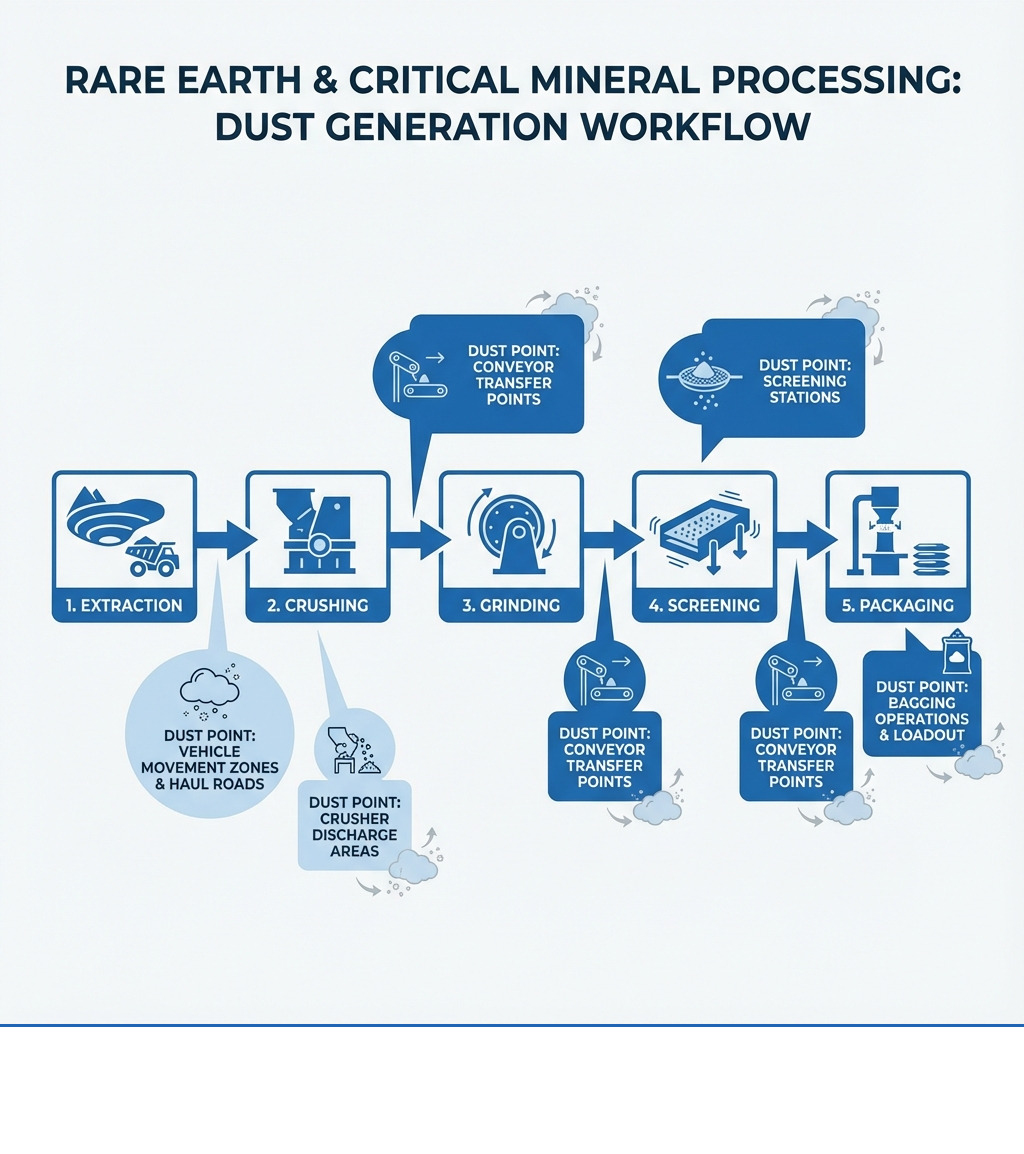
Before we can control dust, we need to know where it’s coming from and how much is being generated. This initial assessment is the bedrock of an effective dust control strategy. We start by thoroughly identifying all potential dust sources within our facility. This often includes:
- Crushers and Grinders: These are primary dust generators as raw materials are broken down.
- Conveyor Transfer Points: Every time material drops from one conveyor to another, dust plumes can be released.
- Screening Stations: Vibrating screens agitate material, creating significant dust.
- Bagging Areas: Packaging finished products can release fine dust into the air.
- Vehicle Movement: Haul trucks and other vehicles on unpaved roads or within dusty areas can stir up considerable amounts of dust.
Once we’ve identified these points, we move to air quality monitoring and dust sampling. This involves using specialized equipment to measure airborne particulate levels, often focusing on PM2.5 and respirable dust fractions. Dust sampling allows us to analyze the composition of the dust, helping us understand its unique hazards (e.g., presence of silica, heavy metals, or radioactive elements). This data is crucial for designing the most effective control measures.
Step 2: Engineer Controls at the Source
The most effective approach to Rare Earth & Critical Mineral Dust Control is to prevent dust from becoming airborne in the first place, or to capture it as close to the source as possible. This is where engineering controls come into play.
One of our primary tools is Local Exhaust Ventilation (LEV). This involves designing and installing a system of capture hoods positioned directly at the dust generation points. These hoods connect to ductwork that draws dust-laden air away from the source, preventing it from dispersing into the general work environment. Properly designed enclosures around crushers, screens, or conveyor transfer points can significantly improve the effectiveness of LEV systems by containing the dust before it can escape.
Another powerful technique is wet suppression. This method uses water or other liquid agents to bind dust particles together, making them too heavy to become airborne.
- Water Sprays: Strategically placed nozzles can spray a fine mist onto material at transfer points, crushers, and stockpiles.
- Misting Systems: Even finer mist, often with added surfactants, can be used to capture smaller particles.
- Foam Agents: For certain applications, foam can be highly effective at encapsulating dust particles, particularly in crushers or at conveyor discharge points.
The key to successful engineering controls is customization. Every facility and every process has unique challenges. That’s why we at Sly, LLC emphasize custom-engineered solutions. Our team of experts can design systems custom to your specific needs, ensuring maximum effectiveness. Learn more about our approach to custom engineering services.
Step 3: Implement Administrative and Work Practice Controls
While engineering controls form the backbone of a dust management program, administrative and work practice controls are equally vital. These are the procedures and behaviors that ensure the engineering controls operate effectively and that workers are protected.
Regular housekeeping is paramount. Dust accumulation on surfaces can become re-entrained in the air with even minor disturbances. We advocate for methods like wet sweeping and industrial HEPA vacuuming over dry sweeping, which can inadvertently kick dust back into the air. Maintaining a clean work environment reduces overall dust levels and minimizes exposure risks.
Worker training programs are non-negotiable. Our team members need to understand the hazards of mineral dust, how dust control systems work, and their role in maintaining their effectiveness. This includes proper use of controls, reporting malfunctions, and adhering to safety protocols.
Establishing designated clean zones where dust-generating activities are restricted can help protect administrative areas and break rooms. Finally, Personal Protective Equipment (PPE), particularly appropriate respirators, is the last line of defense for workers when engineering and administrative controls cannot completely eliminate exposure. Selecting the right type of respirator, ensuring proper fit, and providing regular training on its use and maintenance are critical.
Key Technologies for Rare Earth & Critical Mineral Dust Control
Choosing the right equipment is a critical decision in any Rare Earth & Critical Mineral Dust Control strategy. At Sly, LLC, with our century-plus of experience since 1902, we understand that no two dust challenges are exactly alike. We design and manufacture high-quality, reliable air pollution control systems specifically engineered for demanding industrial applications.
Dry Collection Systems: Baghouse Dust Collectors
For many dry mineral processing applications, baghouse dust collectors are the workhorses of air pollution control. These systems are renowned for their high-efficiency capture capabilities, often exceeding 99.9% for even very fine particulate matter.
At the heart of a baghouse are its fabric filters, which physically capture dust particles as air passes through. We offer various types, including pulse-jet collectors, which use bursts of compressed air to clean the filters, and shaker collectors, which mechanically shake the filters. The selection of the appropriate filter media is crucial, depending on factors like dust particle size, abrasiveness, temperature, and chemical composition. For rare earth and critical mineral dust, we often recommend specialized high-efficiency media capable of handling fine, sometimes abrasive, or even slightly reactive dusts.
Our expertise in baghouse design ensures that we provide robust, no-compromise solutions custom to the unique demands of your operation. From initial design to manufacturing, we focus on delivering systems that provide the cleanest air possible. You can explore our range of baghouse solutions here: More info about baghouse dust collectors.
Here’s a comparison of common filter media for mineral dust applications:
| Filter Media Type | Ventajas | Disadvantages | Common Applications |
|---|---|---|---|
| Polyester | Good general-purpose, cost-effective | Limited temperature, susceptible to hydrolysis | General mineral dust, cement, non-abrasive dust |
| Polypropylene | Good chemical resistance, moisture resistance | Lower temperature limit | Wet or corrosive dusts, chemical processing |
| Aramid (Nomex) | High temperature resistance, good abrasion | Hydrolysis sensitive, moderate chemical resistance | High-temperature mineral processing, kilns |
| Fiberglass | Very high temperature, good chemical resistance | Brittle, poor abrasion resistance | Very hot gases, acid environments |
| PTFE (Teflon) | Excellent chemical, temperature, and abrasion | High cost, lower strength | Highly corrosive, high-temp, sticky dust |
| P84 | High temperature, good chemical, fine particle | High cost, susceptible to hydrolysis | Fine, hot dusts, specific chemical processes |
Wet Collection Systems: Scrubbers
For certain applications, particularly those involving sticky, combustible, or chemically reactive dusts, wet scrubbers offer an ideal solution. Unlike dry collectors, scrubbers use a liquid (typically water) to capture particulate matter.
We offer various types of wet scrubbers, including:
- Sly Impinjet® Scrubbers: Collects particulates and absorb vapors and gases. Low water consumption and minimum pressure drop achieve high collection efficiencies (99% @5 microns).
- Venturi Scrubbers: Known for their high efficiency in capturing sub-micron particles, they accelerate dust-laden gas through a venturi throat, atomizing the scrubbing liquid and causing intense mixing and particle capture.
- Packed-Bed Scrubbers: These are excellent for removing gaseous contaminants in addition to particulates, as gas passes through a packed bed of media wetted with a scrubbing liquid.
Wet scrubbers are particularly advantageous when dealing with mineral dusts that are pyrophoric or have a risk of explosion, as the water extinguishes sparks and renders combustible dust inert. They can also handle mixed dust streams, where both particulate and gaseous contaminants need to be removed, and can even be used for chemical neutralization if the dust is acidic or alkaline. Our wet scrubbers are designed for reliability and high performance, even in the toughest environments. Learn more about our wet scrubber solutions: More info about wet scrubbers.
Choosing the Right Equipment for Rare Earth & Critical Mineral Dust Control
The decision between a baghouse and a wet scrubber, or even a combination of both, depends on several critical factors specific to your operation:
- Dust Characteristics: What is the particle size distribution? Is the dust abrasive, sticky, or hygroscopic? Does it contain radioactive elements or exhibit pyrophoric properties?
- Combustibility: Is the dust combustible or explosive? Wet scrubbers often mitigate this risk more effectively.
- Moisture Content: Is the gas stream humid? Baghouses perform best with dry gas streams, while scrubbers can handle moisture.
- Chemical Properties: Is the dust chemically reactive, acidic, or alkaline? This influences material selection for the collector and the scrubbing liquid.
- Airflow Requirements: The volume of air to be treated dictates the size and capacity of the system.
- Capital Cost vs. Operational Cost: While the initial investment is important, we also consider long-term operating costs, including energy consumption, maintenance, and disposal of collected material (dry dust vs. wet sludge).
Our team at Sly, LLC specializes in analyzing these factors to recommend and design the optimal Rare Earth & Critical Mineral Dust Control system for your facility in Ohio or Mississippi. We pride ourselves on delivering reliable, no-compromise solutions that meet your specific needs for the cleanest air possible.
Best Practices for System Maintenance and Monitoring
A state-of-the-art dust control system is only as effective as its maintenance program. Neglecting regular upkeep can lead to decreased performance, increased emissions, higher operating costs, and eventual system failure. We believe in a proactive approach to ensure your Rare Earth & Critical Mineral Dust Control system consistently operates at peak efficiency.
Creating a Proactive Maintenance Schedule
Developing and adhering to a comprehensive maintenance schedule is crucial. This isn’t just about fixing things when they break; it’s about preventing failures before they occur. Here’s a general checklist that can be adapted for daily, weekly, and monthly tasks:
Daily Dust Collector Maintenance Checklist:
- Check differential pressure gauge readings. Note any significant deviations from normal operating range.
- Visually inspect fan and motor for unusual noises or vibrations.
- Verify proper operation of hopper discharge systems (rotary valves, screw conveyors).
- Check for any visible dust leaks from the collector or ductwork.
Weekly Dust Collector Maintenance Checklist:
- Inspect filter elements (bags or cartridges) for signs of wear, tears, or excessive dust cake buildup.
- Check diaphragm valves and pulse-jet cleaning system for proper cycling (if applicable).
- Inspect solenoid valves and compressed air lines for leaks.
- Examine fan belts for tension and wear.
- Check oil levels in gearboxes (if applicable).
- Clean dust accumulated on the exterior of the collector and surrounding areas.
Monthly Dust Collector Maintenance Checklist:
- Conduct a thorough inspection of all ductwork for corrosion, holes, or blockages.
- Check structural components for integrity and signs of fatigue.
- Inspect paint and coatings for deterioration.
- Verify calibration of pressure gauges and other instrumentation.
- Perform a more detailed inspection of filter cages for damage.
- Check electrical connections and wiring.
- Review maintenance logs for recurring issues.
This proactive approach helps identify minor issues before they escalate into major problems, ensuring continuous and efficient Rare Earth & Critical Mineral Dust Control.
Monitoring Performance for Optimal Rare Earth & Critical Mineral Dust Control
Beyond scheduled maintenance, continuous monitoring provides real-time insights into your system’s health and performance.
- Differential Pressure Gauges: These are critical indicators of filter condition. A rising differential pressure typically means the filters are becoming clogged, while a sudden drop could indicate a torn filter. Consistent monitoring helps optimize cleaning cycles and predict filter replacement needs.
- Airflow Sensors: Ensuring the correct airflow through the system is vital for effective capture velocity at the hoods. Deviations can indicate blockages or fan issues.
- Emission Monitoring: For larger systems or those handling highly hazardous dusts, continuous emission monitoring systems (CEMS) can track particulate emissions, ensuring compliance with environmental regulations.
- Record Keeping: Meticulous records of maintenance activities, pressure readings, and any incidents are invaluable. They help identify trends, troubleshoot problems, and demonstrate compliance during audits.
- Continuous Improvement: We believe in using monitoring data to drive continuous improvement. By analyzing performance trends, we can fine-tune operating parameters, adjust maintenance schedules, and even identify opportunities for system upgrades to further improve Rare Earth & Critical Mineral Dust Control.
Frequently Asked Questions about Mineral Dust Control
We often hear similar questions from facilities dealing with the challenges of mineral dust. Here are some of the most common ones we address:
What makes rare earth element dust more hazardous than other types of mineral dust?
Rare earth element (REE) dust presents unique hazards due to several factors. Firstly, some REEs are naturally associated with radioactive elements like thorium and uranium. When REE-bearing minerals are processed, these radioactive components can become airborne, posing internal radiation exposure risks if inhaled or ingested. Secondly, the fine particulate matter (PM2.5) generated during REE processing can penetrate deep into the lungs, leading to severe respiratory illnesses. Additionally, some REE compounds can be chemically reactive or even pyrophoric, meaning they can spontaneously ignite, adding fire and explosion risks that are not typically associated with common industrial dusts. These combined characteristics necessitate a more rigorous and specialized approach to Rare Earth & Critical Mineral Dust Control.
How do I choose between a wet scrubber and a dry baghouse collector?
The choice between a wet scrubber and a dry baghouse collector depends heavily on the specific characteristics of your dust and your operational environment.
- Baghouse Dust Collectors are generally preferred for dry, non-combustible dusts, offering very high collection efficiencies for fine particulates. They are typically more energy-efficient for large air volumes and produce a dry waste product.
- Wet Scrubbers are ideal for dusts that are sticky, hygroscopic, combustible, or explosive, as the water neutralizes these risks. They are also excellent for gas streams that are hot or contain corrosive gases in addition to particulates. However, they produce a wet sludge that requires further treatment and disposal, and can be less efficient for very fine, non-combustible dusts compared to a well-maintained baghouse. Our team at Sly, LLC can help you evaluate your specific dust characteristics, process conditions, and regulatory requirements to determine the most effective and reliable solution for your Rare Earth & Critical Mineral Dust Control needs.
What are the first steps to take if I notice a dust problem in my facility?
If you’re noticing a dust problem, the very first step is to conduct a thorough assessment. This involves:
- Identify Sources: Pinpoint exactly where the dust is being generated. Walk through your facility and observe operations like crushing, grinding, conveying, and bagging.
- Characterize the Dust: Understand what kind of dust it is. Is it fine? Coarse? Potentially radioactive? Combustible? This might require professional dust sampling and analysis.
- Assess Exposure: Determine who is exposed to the dust and at what levels. Air monitoring can help quantify this.
- Review Current Controls: Evaluate if existing dust control measures are inadequate or malfunctioning.
Once you have this information, you can begin to implement targeted engineering controls at the source, such as local exhaust ventilation or wet suppression, and reinforce administrative controls like improved housekeeping and proper PPE usage. Don’t hesitate to consult with experts like us at Sly, LLC to help you with this assessment and guide you toward a comprehensive solution for your Rare Earth & Critical Mineral Dust Control.
Conclusion: Partnering for a Cleaner, Safer Operation
The stakes are incredibly high when it comes to Rare Earth & Critical Mineral Dust Control. From safeguarding the health of our invaluable workforce to ensuring compliance with strict environmental regulations and maintaining operational efficiency, effective dust management is not just a best practice—it’s an absolute necessity. We’ve explored the critical strategies: implementing robust engineering controls at the source, selecting between advanced wet and dry collection systems, and maintaining vigilance through proactive maintenance and monitoring.
At Sly, LLC, we understand these challenges deeply. For over a century, since 1902, we have been a pioneer in industrial air pollution control, designing and manufacturing custom, high-quality systems like baghouses and wet scrubbers. Our USP is delivering reliable, no-compromise solutions for the cleanest air possible, ensuring your facility in Ohio or Mississippi can operate safely, compliantly, and productively. We don’t just sell equipment; we partner with you to engineer the precise solution your unique operation demands.
Don’t let mineral dust compromise your people, your profits, or your reputation. Let us help you achieve superior Rare Earth & Critical Mineral Dust Control.
Contact us to discuss your mining and mineral processing application.