

Dry, free-flowing dusts like sand or fly ash are usually predictable. They move through ductwork, form a permeable dust cake, and release during pulse-jet cleaning. Sticky chemical dust behaves differently. It can blind filters, reduce capture airflow, and create fire, explosion, and exposure risks.
The Physics of Stickiness
Many industrial chemical powders are hygroscopic, meaning they absorb moisture from ambient air or process gas. A dry powder can become an adhesive paste or slurry when exposed to humidity.
Temperature can make the problem worse. Resins, polymers, and some additives may soften near their melting point or glass transition temperature. Heat and friction inside ductwork can make particles adhere to metal surfaces and filter media.
The Blinding Phenomenon
Dry collectors rely on air passing through filter fibers while dust stays on the surface. For the system to work, the dust cake must remain porous.
Sticky chemical dust often adheres directly to filter fibers instead. Rather than forming a cleanable cake, it creates an impermeable layer called filter blinding.
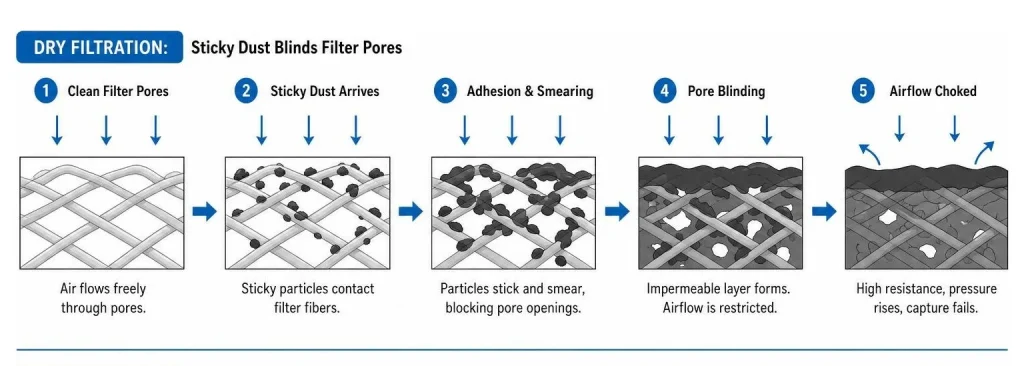
When blinding occurs, several failures follow:
- Differential Pressure Spikes: Resistance across the filters rises quickly.
- Airflow Choking: Capture velocity drops at hoods, allowing dust to escape.
- Shortened Filter Life: Pulse cleaning cannot remove the bonded cake, causing early changeouts and downtime.
The Chemical Reactivity Factor
Some sticky chemical dusts are not inert. In processes handling polymers, adhesives, or resin particles may be partially uncured. Once captured, they can continue cross-linking and permanently bond to the filter media. The result can be a solid, blocked filter element that cannot be cleaned.
Explosion and Fire Risks
Damp or sticky dust can still be combustible. Sticky organic or metallic particulates suspended in a high-velocity air stream can reach their Minimum Explosible Concentration (MEC).
Sticky chemical dusts are also prone to static charge accumulation. Non-conductive particles rubbing against each other and the filter media can generate high voltage. Without proper grounding and static-dissipative media, a spark can ignite a dust cloud inside the collector.
For a deeper look into reactive materials, read our guide on how to master lithium dust collection for safety and efficiency.
What Industries Struggle Most with Sticky Chemical Particulates?
Several sectors regularly manage sticky chemical dusts while meeting strict safety and compliance requirements:
- Pharmaceutical Manufacturing: Active pharmaceutical ingredients (APIs), binders, and excipients can be hygroscopic and have low exposure limits.
- Plastics and Polymer Processing: Resin grinding, mixing, and conveying can generate sticky, static-prone polymer dust.
- Battery Manufacturing and Critical Minerals: Lithium, cobalt, nickel, manganese, and rare earth compounds may be reactive, toxic, and moisture sensitive.
To learn more about these materials, explore our essential strategies for rare earth and critical mineral dust control.
How Does the Dust Explosion Pentagon Apply to Sticky Chemical Dust?
A dust explosion requires five elements: fuel, oxygen, dispersion, confinement, and ignition.
Within a dry dust collector, all five can be present:
- Fuel: Combustible chemical dust.
- Oxygen: Air moving through the system.
- Dispersion: Pulse cleaning can loft dust into suspension.
- Confinement: The enclosed collector housing.
- Ignition: Static discharge, friction sparks, or hot process gas.
Because sticky dusts are often non-conductive, particle movement across dry media can generate static charge. If the Minimum Ignition Energy (MIE) is low, one discharge inside the confined collector can trigger a primary explosion and possible secondary explosions in the facility.
How Do Wet Scrubbers Compare to Dry Collectors for Sticky Dust?
The safest dust collection method for sticky chemical dust depends on moisture, reactivity, combustibility, and whether the plant must recover dry product. The main choice is between wet scrubbing and dry filtration.
| Feature / Metric | Wet Particulate Scrubbers | Dry Baghouse Collectors | Dry Cartridge Collectors |
|---|---|---|---|
| Sticky Dust Tolerance | Excellent (No filters to blind; liquid continuously washes particles away) | Moderate (Requires specialized PTFE membranes and pre-coating) | Poor (Pleated design traps sticky dust; blinds rapidly) |
| Explosion Safety | Inherently Safe (Water eliminates ignition sources and saturates dust) | High Risk (Requires expensive explosion venting and isolation) | High Risk (Requires extensive explosion protection systems) |
| Fine PM Efficiency | High to Very High (Up to 99% with Venturi designs) | Very High (99.9% with proper membrane media) | Extremely High (99.97% with HEPA after-filters) |
| Maintenance Complexity | Low to Moderate (Sump cleanout, liquid level monitoring) | High (Bag changeouts, pulse-system maintenance) | High (Frequent cartridge replacements in sticky apps) |
| Capital Cost (CAPEX) | Moderate | High (When adding required NFPA safety systems) | Moderate to High |
The Wet Scrubber Advantage
For sticky, moist, or highly combustible chemical dusts, wet scrubbers are often the safest primary technology. They use liquid, typically water, as the collection medium rather than fabric filter pores.
Because there are no pores to plug, wet scrubbers cannot blind like dry filters. The liquid encapsulates sticky particles, neutralizes adhesion, and carries them to a sump. This also reduces static buildup and dust cloud ignition risk.
Discover more in our guide on wet dust collectors for hazardous particulates and cleaner operations.
The Dry Collector Alternative
Some applications require dry collection because the dust reacts with water, water use is limited, or the plant wants to reclaim dry powder.
In those cases, a dry baghouse can be engineered with advanced filter media, surface treatments, static control, and explosion protection. Standard cartridge collectors are usually avoided for sticky dust because pleated media traps adhesive material and plugs quickly.
For a broader overview, see our industrial dust control ultimate guide.
How Do Wet Scrubbers Safely Neutralize Sticky Chemical Dust?
Wet scrubbers remove particles through gas-liquid contact, followed by droplet separation and sludge removal.
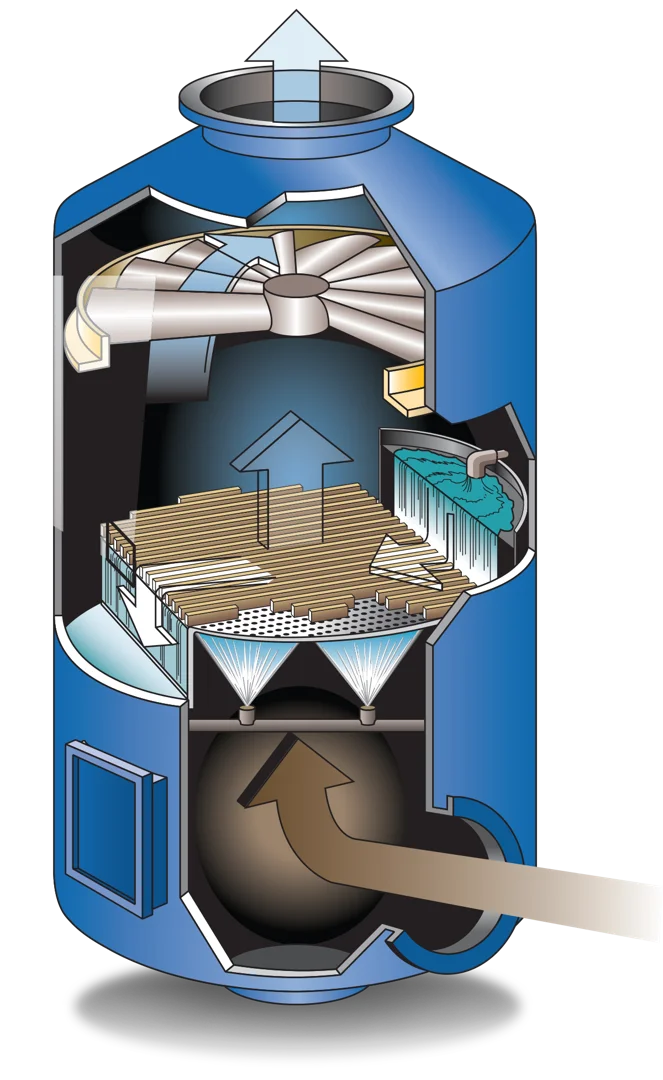
Épurateurs Venturi
Venturi scrubbers are effective for fine sticky particles and high dust loading. The gas stream accelerates through a converging throat where scrubbing liquid is injected. High turbulence atomizes the liquid into droplets, and sticky particles impact and become encapsulated. A downstream separator removes the dust-laden droplets so cleaned air can exit.
Impingement Plate Scrubbers
For larger particles or lower pressure drop applications, impingement plate scrubbers may be suitable. They force dirty air through wetted plates, creating sharp directional changes that drive particles into liquid.
Sludge Management
Captured solids settle in the sump as slurry. To maintain performance, suspended solids in the scrubbing liquid should be controlled, commonly below 5%. Drag-chain conveyors, clarification units, or blowdown systems remove concentrated slurry for disposal or recycling.
When Can Dry Baghouses Be Safely Used for Sticky Dust?
If a dry system is required, the design must use suitable filter media, static dissipation, cleaning energy, and combustible dust protection.
The Role of Filter Media
Standard polyester felt often fails in sticky service. A laminated Polytetrafluoroethylene (PTFE) membrane provides a low-friction surface and keeps dust on the media surface instead of allowing it to embed in the felt. This improves release during cleaning.
Anti-Static and Epitropic Media
Conductive media may be required to reduce static ignition risk. Stainless steel fibers or carbon-infused, epitropic acrylic fibers create paths for charge to move from the dust cake through the filter and into the grounded collector.
Pulse-Jet Cleaning Dynamics
Pulse-jet cleaning uses short bursts of compressed air to flex filter bags and release dust from the PTFE surface. In sticky applications, pulse timing, air pressure, and hopper discharge must be engineered together so released dust does not re-adhere or bridge.
To keep a dry system operational, follow our comprehensive baghouse maintenance checklist for peak performance.
What Are the Cost, Energy, and Environmental Trade-offs?
- Capital Expenses (CAPEX): A basic wet scrubber may cost less than a dry baghouse with explosion vents, isolation valves, rotary airlocks, and suppression.
- Operating Expenses (OPEX): Dry baghouses often run at lower pressure drop, while high-energy Venturi scrubbers need more fan horsepower. Dry systems also carry filter replacement and downtime costs.
- Water Treatment and Disposal: Wet scrubbers generate sludge or wastewater. Plants must compare treatment, recycling, and disposal costs against dry dust handling and filter maintenance.
How Should a Safe Dust Collection System Be Designed and Maintained?
A safe system for sticky chemical dust should be engineered around the specific dust profile, not selected as an off-the-shelf collector. Moisture behavior, particle size, toxicity, combustibility, corrosion potential, and disposal requirements all affect the design.
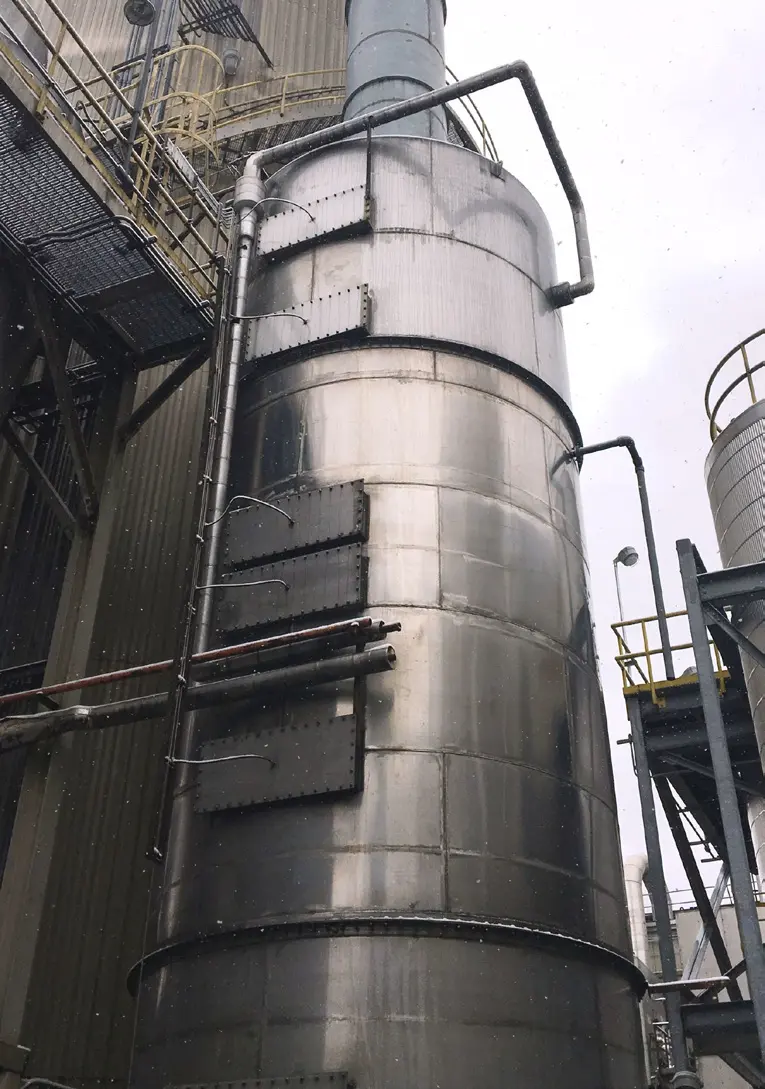
Material Selection
Sticky chemical dusts can be corrosive or reactive. Internal surfaces should resist corrosion and reduce adhesion:
- 316L Stainless Steel: Provides corrosion resistance and can be polished to reduce dust buildup.
- Fiberglass Reinforced Plastic (FRP): Useful in wet scrubbers handling corrosive gases and sticky chemical particulate.
- Specialized Epoxy Coatings: Can protect carbon steel with a smooth, chemical-resistant barrier.
Ductwork Design
Ductwork is a common failure point. If velocity drops below transport velocity, sticky dust settles in horizontal runs, restricts airflow, and creates a fuel source.
Ductwork should include:
- High conveying velocities, typically 4,000 to 4,500 feet per minute for chemical dusts.
- Smooth, long-radius elbows instead of sharp bends.
- Accessible cleanout ports for inspection and removal of buildup.
What Safety Features Are Required for Combustible Sticky Dust?
Combustible sticky dust in a dry collector requires compliance with NFPA 660 and a documented hazard analysis.
Explosion Venting and Suppression
Dry collectors may require explosion relief panels that vent deflagration pressure and flame to a safe location. If outdoor venting is not practical, active chemical suppression may be needed to detect pressure rise and inject extinguishing agent.
Isolation Valves
Fast-acting mechanical isolation valves or float-type isolation valves help prevent an explosion from propagating back through inlet ductwork. Rotary airlocks at hopper discharge help maintain a physical seal.
System Grounding and Bonding
Duct sections, hoods, collector housings, filter cages, and fan assemblies must be bonded and connected to verified earth ground. This reduces voltage differences that can create static sparks.
What Maintenance Protocols Prevent Catastrophic System Failures?
Preventive maintenance is critical for sticky chemical dust service.
- Differential Pressure Monitoring: A sustained upward trend across dry filters signals blinding and allows planned changeout before airflow collapses.
- Wet Scrubber Sump Maintenance: Operators should monitor liquid level, pH, and suspended solids. Automated blowdown and make-up water help keep solids concentration below 5% and reduce scaling or nozzle plugging.
- Safe Change Containment: For toxic or highly active dusts such as pharmaceutical APIs proper safety procedures must be followed.
How Can Sly Help Solve Your Sticky Chemical Dust Challenges?
Sly, LLC designs custom dry dust collectors, wet scrubbers, and integrated air pollution control systems for complex industrial applications.
Over a Century of Engineering Expertise
Since pioneering the first cloth-type dust collector in 1902, Sly has helped industrial facilities solve demanding particulate and gas control problems. Systems are engineered from facilities in Strongsville, Ohio, and Mathiston, Mississippi, around the physical and chemical demands of the application.
Single-Source Capability for Dry and Wet Technologies
Sly designs and builds both dry dust collectors, including baghouses and cartridge systems, and wet scrubbing systems, including FRP packed towers and Venturi scrubbers. This allows an unbiased approach when a wet system, dry system, or multi-stage system is the best fit.
Custom Engineering for Your Exact Dust Profile
Sly application engineers help evaluate process conditions, dust characteristics, materials of construction, filter media, and safety requirements. The goal is reliable compliance, lower lifecycle cost, and safer operation.
If you are evaluating a multi-stage dust and gas control system, or struggling with a blinding sticky dust application, Sly’s application engineers can help review your project and design a compliant solution.