

What Are the Real-World Consequences of Ineffective Dust Suppression?
When industrial dust control systems fail, the fallout ripples across occupational health, safety, equipment reliability, and environmental compliance.
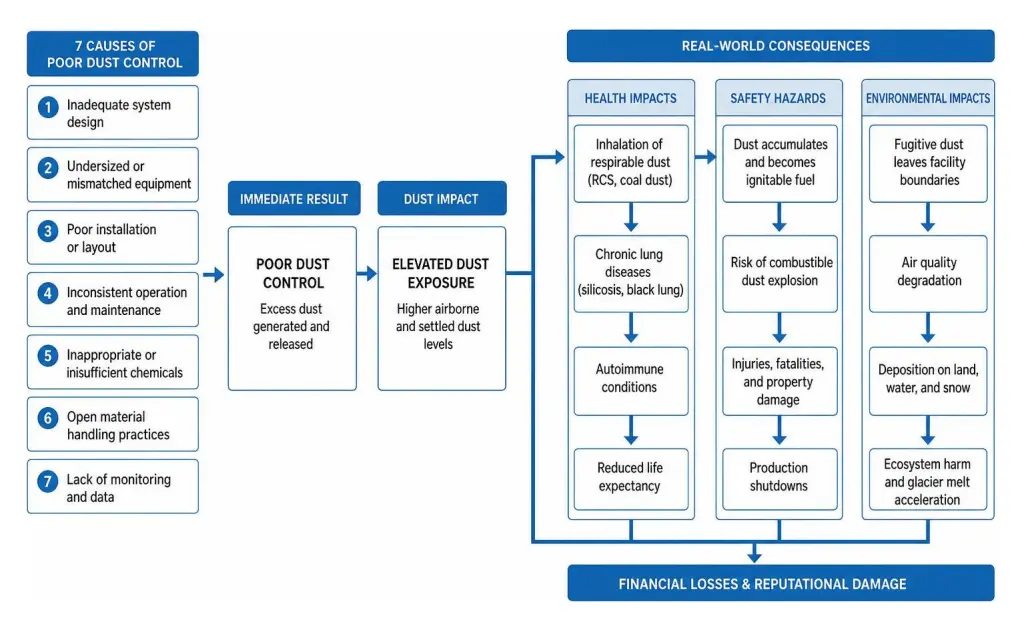
From a health perspective, respirable dust (particles 10 microns or smaller) poses the greatest threat. Unlike larger nuisance dust, respirable crystalline silica (RCS) and coal dust penetrate deep into the lungs, causing irreversible diseases like silicosis and black lung. The severity of this hazard is underscored by the fact that the life expectancy of underground mine workers is 20 years shorter than the general population.
Furthermore, a systematic review of the effectiveness of dust control measures revealed a stark gap between implemented controls and actual exposure. Out of the analyzed studies, 55.0% of operations handling respirable crystalline silica and 79.3% of operations handling respirable coal dust reported a high risk of worker overexposure.
Beyond chronic health risks, poor dust control creates immediate safety hazards, most notably catastrophic combustible dust explosions. Five components are required to trigger a dust explosion:
- Fuel: Ignitable fine dust accumulated on surfaces.
- Ignition Source: A spark, static discharge, or hot surface.
- Oxidizer: Oxygen in the ambient air.
- Suspension: A sudden disturbance that lofts the dust into a cloud.
- Confinement: An enclosed room, duct, or vessel that allows pressure to build.
Operationally, fugitive dust accelerates equipment wear. When abrasive particulates bypass filtration, they settle into bearings, clog engine air intakes, and increase fuel consumption by 15 to 30% on haul vehicles. Environmentally, light-absorbing impurities from black coal and mineral dust settle on snow and glaciers, accelerating melting. In Central Asia, mineral dust deposition contributes to approximately 16% of total glacier melt.
Why Do Companies Struggle to Achieve 95 to 99% Dust Reduction?
Despite highly efficient air pollution control equipment, many facilities struggle to achieve consistent 95 to 99% dust reduction due to economic, operational, and regulatory barriers.
Economically, many companies prioritize low upfront capital expenditure over long-term lifecycle savings. They choose off-the-shelf, undersized collectors or cheap chemical suppressants rather than custom-engineered solutions. This short-term focus overlooks the fact that proper dust control on haul roads alone can reduce road maintenance by 50% and water consumption by 90 to 95%, yielding massive operational savings.
Operationally, many plants rely on outdated, reactive methods. Spraying water continuously on a dusty conveyor transfer point or haul road is a common default. However, water evaporates rapidly, often within 10 to 25 minutes in dry conditions, and can wash away the fine binding materials that hold unpaved surfaces together, worsening the dust problem over time.
Regulatorily, a major disconnect exists because plants often treat worker exposure limits governed by OSHA (such as 29 CFR 1910.1000) and ambient emission caps governed by the EPA as separate challenges. In reality, indoor air quality and outdoor stack emissions are part of a single, connected air balance loop. To help facilities navigate these complexities, our Industrial Dust Control Ultimate Guide provides a comprehensive framework for transitioning from reactive, localized fixes to preventive, system-wide engineering.
Achieving pristine air quality requires every component of an air pollution control system to work in harmony. When dust escapes, it is rarely the fault of a single component. Rather, it is typically the result of specific technical, design, or operational failures. Below, we examine the top seven causes of poor industrial dust control and how they sabotage your air quality goals.
1. Improper Hood Design and Poor Source Capture
The first line of defense in any local exhaust ventilation (LEV) system is the hood. If a hood cannot capture dust at the exact point of generation, the rest of the dust collection system is rendered useless.
Many systems fail because they do not apply the “Three Cs” of proper hood engineering:
- Containment: Enclosing the dust-producing process as much as possible to limit the volume of air that must be exhausted.
- Capture: Directing the exhaust airflow path directly through the path of the generating dust.
- Control: Providing sufficient exhaust volume and velocity to overcome cross-drafts and pull the dust into the ductwork.
A common mistake is placing the hood too far from the dust generation point. Because capture velocity decreases exponentially as distance from the source increases, even a minor cross-draft can easily disperse fine respirable particles into the worker breathing zone before the hood can capture them. As detailed in Processing Magazine’s guide on dust collection system failures, improper hood design remains one of the most common reasons why systems fail to protect facilities, even when the collector itself is operating perfectly.
2. Inadequate Airflow Engineering and Duct Sizing
Once dust is captured, it must be transported to the collector. This requires precise duct velocity engineering. If the air velocity inside the duct falls below the minimum transport threshold, dust will settle out of the airstream and accumulate inside horizontal duct runs.
The industry standards for minimum transport velocities are:
- 4,000 feet per minute (fpm): For typical non-combustible industrial dusts.
- 4,500 fpm: For combustible dusts, as recommended by the National Fire Protection Association (NFPA) to prevent fuel accumulation inside the ductwork.
When dust settles in the ducts, it restricts airflow, increases system static pressure, and creates a severe combustible dust hazard. This problem can sometimes be compounded by using manual balancing methods, such as dampers or bleed-in air valves, to balance multi-branch duct systems. These mechanical adjustments restrict airflow and are prone to tampering.
Instead, systems should rely on a physics-based “Balanced-by-Design” manifold system, which uses precise duct diameters and junction angles to maintain self-cleaning velocities naturally. In The Definitive Guide to Baghouse Dust Collectors, we outline how proper ductwork manifolding and plenum design prevent drop-out and maintain critical transport velocities throughout the system.
3. Incorrect Dust Collector Selection for the Application
A dust collector is not a one-size-fits-all machine. Selecting the wrong type of collector for your specific process conditions will lead to rapid system failure.
For instance, using dry cartridge collectors in high-moisture, sticky, or hygroscopic dust environments leads to rapid filter blinding. Cartridge filters have tight pleats that easily bridge with damp dust, choking off airflow. Additionally, exceeding safe air-to-media ratios (the volume of air passing through each square foot of filter media) is a frequent design flaw.
Furthermore, dry dust collectors are often inappropriate for hazardous, sticky, or highly explosive particulates. In these scenarios, wet dust collectors are the safer, more reliable choice. Wet systems encapsulate dust particles in liquid droplets, eliminating the risk of dry dust explosions and preventing sticky materials from cementing onto dry fabric filters. To understand which technology fits your process, read our guide on Wet Dust Collectors: Your Solution for Hazardous Particulates and Cleaner Operations.
4. Poor Sealing Performance and Equipment Leaks
Even the most efficient filter media cannot prevent dust emissions if air can bypass the filters entirely. Poor sealing performance is a silent saboteur of dust filtration systems.
This issue typically stems from:
- Improper Sealing Materials: Cheap, standard neoprene gaskets can dry out, crack, or break down in high-temperature or chemically corrosive applications.
- Unreasonable Sealing Structures: Warped access hatches, poorly machined door latches, or misaligned tube sheets create gaps where dirty air bypasses filtration.
- Improper Bag Installation: Filter bags that are not fully seated, tensioned correctly, or clamped securely can leak around the cuff, sag into the dirty-air stream, or wear prematurely. Even one poorly installed bag can allow dust to escape and raise emissions.
To prevent bypass leakage, critical joints and access doors should utilize high-performance, resilient sealing materials like silicone or fluororubber, which maintain their elasticity under harsh operating conditions. Regular maintenance teams should perform visual inspections and pressure decay tests around doors, hopper connections, and dirty-air plenums to identify and seal leaks immediately.
5. Inadequate Collected Material Discharge and Hopper Accumulation
A dust collector’s hopper is designed strictly as a temporary transit funnel to direct captured dust to a discharge valve. It is not a storage bin.
When facilities fail to maintain a continuous, first-in, first-out material discharge schedule, dust builds up inside the hopper. This leads to several critical issues:
- Material Bridging and Clogging: Fine dust packs together, bridging over the outlet and completely blocking discharge.
- “Hammer Rash”: Frustrated operators often use sledgehammers to strike the hopper walls to encourage material flow, denting the metal and creating internal pockets that worsen bridging.
- Filter Re-Entrainment: Accumulated dust rises to the level of the filter elements, where the high-velocity inlet air sweeps the dust back onto the filters, causing rapid blinding and high differential pressure.
To avoid these failures, hoppers must be paired with properly sized rotary valves or double-dump valves. Our Baghouse Bliss: A Comprehensive Maintenance Checklist for Peak Performance outlines the daily and weekly inspection protocols required to keep hoppers empty and discharge systems operating smoothly.
6. Production Expansion Without System Re-Evaluation
When a manufacturing plant expands production, managers often add new dust-producing machinery, conveyor transfer points, or packaging lines. A common mistake is ducting these new pickup points directly into the existing dust collection system without re-evaluating the system’s capacity.
Adding pickup points to an existing system without upgrading the fan or collector leads to:
- Reduced Capture Velocity: The available static pressure and airflow are divided among more hoods, causing the velocity at every hood to drop below the minimum capture threshold.
- Duct Settling: Total system airflow drops, causing transport velocities inside the main duct runs to fall below 4,000 fpm, leading to dust drop-out and clogging.
- Overloaded Filter Media: The increased dust loading exceeds the design capacity of the baghouse, causing high differential pressure and premature filter failure.
Any process change, production expansion, or modification to material chemistry requires a comprehensive engineering audit of the entire air pollution control system.
How Can Facilities Diagnose and Resolve Dust Control Failures?
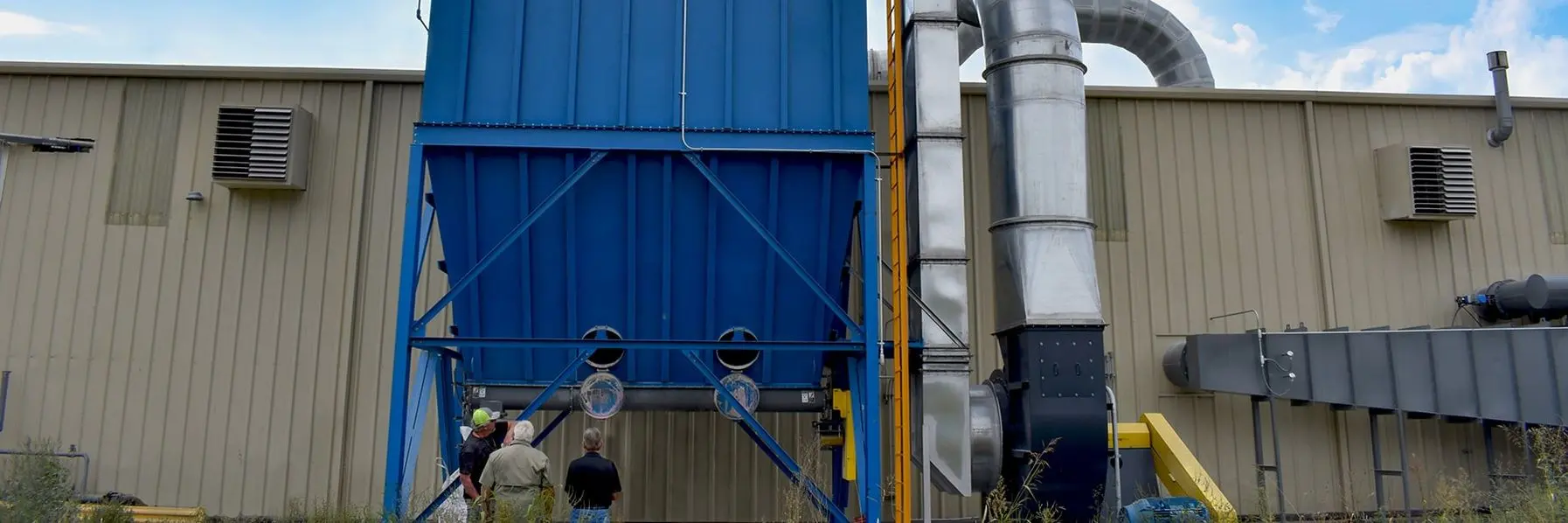
Resolving chronic dust control issues requires moving away from reactive troubleshooting and adopting a systematic, predictive maintenance approach. Use the guide below to diagnose, optimize, and maintain your air pollution control systems.
| Technology Type | Particulate Collection Efficiency | Relative Capital Cost | Best Application Suitability |
|---|---|---|---|
| Dry Baghouse | Very High (Up to 99.9% for fine dust) | Moderate to High | Dry, non-sticky, non-hygroscopic bulk materials handling and processing. |
| Nasswäscher | High (99% for particles > 1 micron) | Moderate | High-moisture, high-temperature, sticky, or explosive/combustible particulates. |
| . |
How Do You Conduct a Dust Control System Audit?
To find the root cause of poor performance, conduct a thorough system audit using these steps:
- Measure Hood Static Pressure: Use a pitot tube and manometer to verify that each hood has sufficient static pressure and capture velocity to entrain dust at the source.
- Verify Duct Velocities: Measure air velocity in horizontal duct runs to ensure it meets the minimum 4,000 fpm (non-combustible) or 4,500 fpm (combustible) transport threshold.
- Inspect Filter Media: Check the clean-air plenum for signs of dust bypass, which indicates torn bags or leaking seals. If you suspect filter issues, consult our guide on How to Replace Your Baghouse Filters for Optimal Performance to diagnose failure modes and execute proper changeouts.
- Analyze Airflow Distribution: Uneven airflow causes localized filter wear and premature blinding. Advanced engineering tools, such as Computational Fluid Dynamics (CFD) modeling, can simulate airflow patterns inside the collector inlet to identify and correct high-velocity wear zones.
What Is the Role of Automated Monitoring and Maintenance?
Automated monitoring systems eliminate guesswork and prevent unexpected downtime. Key components to integrate into your system include:
- Differential Pressure (DP) Transmitters: Continuous DP monitoring tracks dust cake buildup on the filters. This data should be used to trigger pulse-jet cleaning cycles only when needed, rather than running on a continuous timer. This extends filter life and reduces compressed air costs, as explained in our guide on Pulse Jet Filter Cleaning.
- Broken Bag Detectors: These triboelectric dust monitors detect particulate emissions in the exhaust stack, alerting maintenance teams to filter leaks long before visible dust escapes.
- Rotary Valve Interlocks: Automated sensors can detect rotary valve failures or hopper high-material levels, shutting down upstream processes before dust backs up into the collector.
How Can Sly Help Optimize Your Air Pollution Control System?
Sly designs and manufactures custom, high-quality industrial air pollution control systems like baghouses and wet scrubbers. As a pioneer since 1902 with the first cloth-type dust collector, Sly delivers reliable, no-compromise solutions for the cleanest air possible.
Our engineers act as trusted advisors, evaluating your unique process chemistry, dust characteristics, and regulatory requirements. Because we design and build both dry dust collectors and wet scrubbers, we can provide unbiased, multi-stage systems from a single source, reducing your project risk and lowering long-term operating costs.
If you are ready to resolve your dust control challenges, explore Sly’s Industrial Air Pollution Control Services or contact our engineering team directly at Sly, LLC.
Frequently Asked Questions (FAQs)
What is the minimum duct velocity required to prevent dust from settling?
For typical non-combustible industrial dusts, duct velocity must be maintained at a minimum of 4,000 fpm. For combustible dusts, the NFPA requires a minimum transport velocity of 4,500 fpm to prevent hazardous dust accumulation inside the ductwork.
How does incorrect air-to-media ratio affect a baghouse?
An air-to-media ratio that is too high means too much air is being forced through too little filter area. This causes high differential pressure, deep particle embedding (blinding), rapid filter wear, and excessive energy consumption from the system fan.
When should I use a wet scrubber instead of a dry baghouse?
Wet scrubbers are preferred when handling high-moisture or high-temperature exhaust streams, sticky or hygroscopic particulates that would blind fabric filters, or in some cases combustible and explosive dusts that present a fire hazard in dry collectors.