

Tackling Hazardous Dust with Water

A wet dust collector is an air pollution control system that uses water or other liquids to capture and remove harmful particulates from industrial exhaust streams. Unlike dry filters, wet collectors scrub contaminated air by bringing dust particles into contact with liquid, which traps them and safely removes them from your facility.
Key advantages of wet dust collectors:
- Safety first – Eliminates explosion risks from combustible dust by keeping particles wet
- Handles tough materials – Captures sticky, hot, or corrosive dust that clogs dry filters
- Meets regulations – Helps achieve OSHA and NFPA compliance for hazardous particulates
- Versatile applications – Works for metal grinding, silica dust, chemical processing, and more
If your facility deals with combustible dust, sticky materials, or high-temperature particulates, a wet dust collector might be your best solution. These systems excel where traditional dry collectors fail or create safety hazards.
The water-based approach works by forcing dust-laden air through liquid droplets or sprays. Particles stick to the water, fall out of the airstream, and collect as a liquid solution that you can safely dispose of. The scrubbed air exits clean, protecting both your workers and the environment.
This guide walks you through wet dust collector types, applications, and how to select the right system for your specific needs. We’ll cover everything from basic principles to maintenance requirements, helping you make an informed decision about cleaner, safer operations.
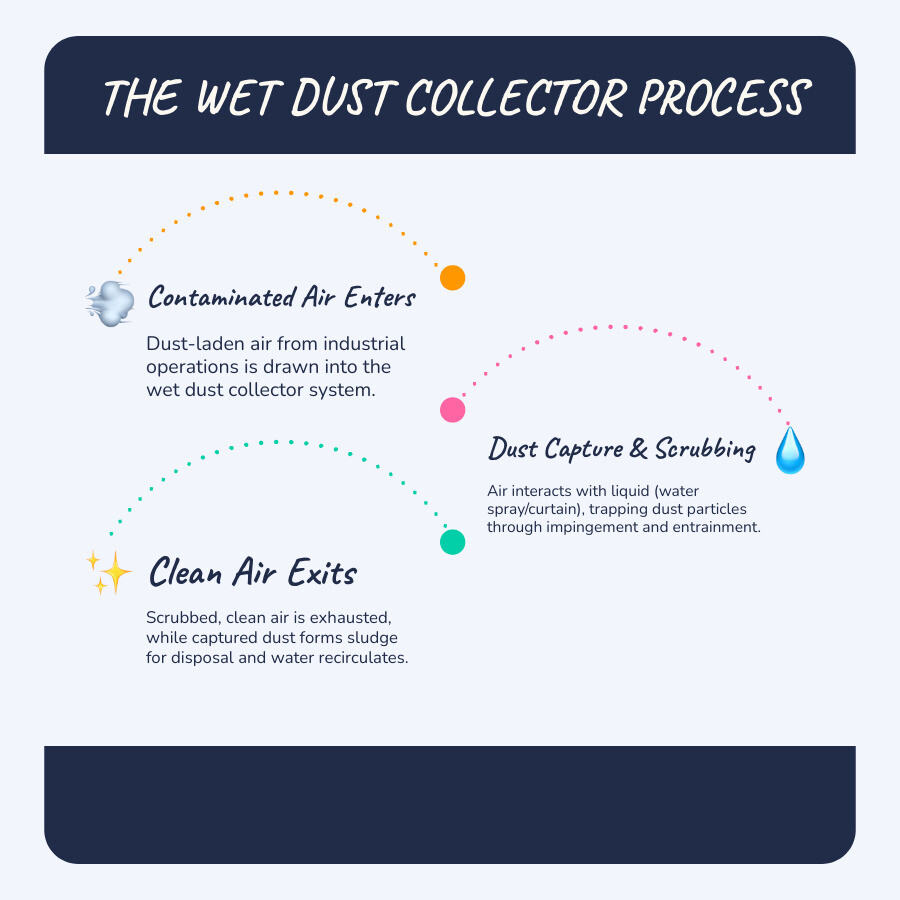
How Wet Dust Collectors Capture Harmful Contaminants
At its heart, a wet dust collector is a master of elemental combat: water versus dust. The magic happens through a process called scrubbing, where contaminated air is brought into intimate contact with a scrubbing liquid, typically water. This ensures that even the most stubborn or dangerous particulates are effectively removed from the air we breathe and the environment we work in.
Imagine a microscopic wrestling match. Dust-laden air enters the collector. Inside, the scrubbing liquid is introduced, often as a fine spray, a turbulent pool, or a cascading curtain. As the dirty air passes through this liquid barrier, several mechanisms kick in to capture the particulates:
- Impingement: Larger dust particles, due to their inertia, cannot follow the airstream around the water droplets. They “impact” or impinge directly onto the liquid surface and become trapped.
- Entrainment: Smaller particles get caught in the turbulent eddies created by the air and water interaction. They become “entrained” or embedded within the water droplets.
- Diffusion: REMOVE THIS ALTOGETHER
- Condensation: If the air is hot and humid, water vapor can condense on the particles, making them heavier and easier to capture.
Once captured, these dust-laden water droplets fall out of the airstream due to gravity. They collect at the bottom of the unit. This liquid, now containing the particulates, can then be safely removed for disposal or further treatment. Meanwhile, the cleaned air exits the collector through the exhaust, often after passing through a mist eliminator to remove any lingering water droplets.
Many wet dust collector systems also incorporate sophisticated water recirculation systems. This means the scrubbing liquid, after it has captured dust, is reused, reducing water consumption and operational costs. We carefully design these systems to ensure continuous, efficient particulate capture while minimizing resource use.
Benefits of a Wet Dust Collector for Combustible Dust
When it comes to handling combustible dust, safety isn’t just a priority; it’s a non-negotiable requirement. This is where a wet dust collector truly shines and provides unparalleled peace of mind. Unlike dry collection systems that can inadvertently create conditions ripe for dust explosions, wet collectors inherently mitigate this critical risk.
Combustible dust, when suspended in air in the right concentration and exposed to an ignition source, can lead to devastating explosions. Industries dealing with materials like wood, grains, metals (such as aluminum or magnesium), plastics, and certain chemicals face this constant threat. Our primary goal is to ensure the safety of your facility and personnel.
By introducing water into the collection process, wet dust collectors keep combustible dust particles wet and saturated. This simple yet effective action minimizes the formation of an explosive dust cloud. This fundamental difference translates into significant safety improvements for operations that generate such hazardous particulates.
Adhering to standards set by organizations like the National Fire Protection Association (NFPA) is crucial. NFPA guidelines, particularly those concerning combustible dust, often recommend or even mandate specific control measures to prevent explosions. A wet dust collector is an excellent solution for meeting these stringent requirements. Furthermore, OSHA provides comprehensive information on Combustible Dust hazards explained by OSHA, which underscores the seriousness of these risks and the importance of effective control.
Beyond regulatory compliance, the use of a wet dust collector can also positively impact your insurance requirements and premiums. Insurers recognize the reduced risk profile associated with wet collection systems for combustible dust, potentially offering more favorable terms. Investing in a robust wet dust collector is an investment in safety, compliance, and the long-term operational stability of your facility. It’s about ensuring everyone goes home safe at the end of the day.
Wet vs. Dry Dust Collection: Making the Right Choice
Choosing between a wet dust collector and a dry system is a critical decision that impacts safety, efficiency, and cost. While both aim to clean the air, their methods and ideal applications differ significantly. We’ve put together a comparison to help you steer this choice.
| Feature | Wet Dust Collector | Trockener Staubabscheider |
|---|---|---|
| Dust Type | Combustible, sticky, hygroscopic, hot, explosive, corrosive, fine particulates | Non-combustible, dry, non-sticky, coarse, granular, ambient temperature |
| Safety | Excellent for combustible dust (eliminates explosion risk), handles sparks/flames | High explosion risk for combustible dust (requires explosion protection), fire risk for hot materials |
| Maintenance | Liquid handling, water treatment, corrosion prevention, nozzle/fan checks | Filter replacement, bag cleaning, wear on internal components |
| Cost | Higher initial capital, ongoing water disposal costs, lower fire insurance often | Lower initial capital, ongoing filter replacement costs, higher fire insurance often |
| Efficiency | Very high for fine particles, gases, and mists | High for larger particles, can struggle with sub-micron dust |
| Footprint | Can be more compact for certain applications | Often requires significant space for filter banks |
| Disposal | Liquid solution (can be messy, requires proper handling) | Dry dust (easier to handle, but can be re-entrained) |
When do we lean towards a wet dust collector?
- Sticky Dust: Materials that gum up dry filters, like certain food powders or resins, are no match for water. The liquid washes them away, preventing clogging.
- Hygroscopic Materials: Substances that absorb moisture from the air can become problematic in dry systems. Wet collectors handle this naturally.
- Corrosive Gases: Some wet dust collector designs, particularly scrubbers, can also absorb and neutralize corrosive gases in addition to particulate removal.
- Fire Risks & Sparks: Operations involving grinding metals, welding, or high-temperature processes that produce sparks or hot particulate benefit immensely. The water immediately quenches any ignition sources, preventing fires and explosions.
- Combustible Dust: As discussed, this is perhaps the most compelling reason. Keeping dust wet is the safest way to handle it.
- Moisture Content: If the process air already has high moisture content, a dry system might struggle, making a wet dust collector a more natural fit.
While dry collectors are excellent for many applications, particularly those with non-combustible, dry, and coarse dust, their limitations become apparent with hazardous, sticky, or hot materials. The efficiency trade-offs are also important; wet dust collectors can be incredibly effective at capturing very fine particulate matter and even certain gaseous contaminants, areas where dry filters might struggle or require additional specialized equipment. We help you weigh these factors to select the optimal solution for your specific needs.
Critical Applications: When to Use a Wet Dust Collector
The versatility and inherent safety benefits of wet dust collector systems make them indispensable across a wide array of industries, particularly where hazardous, sticky, or hot particulates are a concern. We often recommend a wet dust collector for critical applications where robust air pollution control is paramount.
Here are some scenarios where a wet dust collector truly excels:
- Silica Dust: Operations involving sand, concrete, or stone cutting generate crystalline silica dust, a known respiratory hazard. Wet collectors effectively capture this fine, dangerous particulate, preventing it from becoming airborne.
- Sand Processing & Mineral Processing: From foundries to quarries, these industries produce significant amounts of abrasive dust. A wet dust collector can handle the high dust loads and often abrasive nature of these materials without rapid wear on filter media. We have experience in Dust control in mineral processing and understand the unique challenges.
- Metal Grinding & Finishing: Processes like grinding, polishing, and deburring of metals (especially aluminum, magnesium, or titanium) create fine, often combustible dust and sparks. The water in a wet dust collector immediately quenches sparks and wets combustible metal dust, drastically reducing fire and explosion risks.
- Food Processing: Certain food ingredients can be sticky, hygroscopic, or combustible. Wet collectors are ideal for capturing these powders, preventing blockages, and maintaining hygienic conditions.
- Pharmaceutical Manufacturing: In pharmaceutical production, fine powders are common. A wet dust collector can provide high-efficiency particulate removal, crucial for product quality and worker safety, especially when dealing with potent compounds.
- Chemical Plants: Many chemical processes involve corrosive, explosive, or sticky particulates and fumes. Specialized wet dust collector designs can not only capture these particulates but also absorb hazardous gases, offering a dual-purpose solution.
These industries often face strict environmental regulations and high safety standards. A wet dust collector provides a reliable and compliant solution, ensuring cleaner operations and a safer working environment for everyone involved.
Choosing the Right Wet Dust Collector for Your Industry
Selecting the perfect wet dust collector isn’t a one-size-fits-all decision; it’s a careful process of matching technology to your unique operational needs. Our expertise lies in conducting a thorough application analysis to ensure we design and provide the most effective and efficient solution for your facility.
Here are the key factors we carefully consider:
- Dust Characteristics: This is paramount. Is the dust combustible, sticky, abrasive, hygroscopic, or corrosive? What is its particle size distribution? Is it hot? Understanding these properties dictates the type of scrubbing liquid, construction materials, and specific collector design. For instance, highly abrasive dust might require specialized wear-resistant linings.
- Airflow Requirements: What volume of air needs to be cleaned? This is typically measured in cubic feet per minute (CFM) or cubic meters per hour (CMH). This directly influences the size and capacity of the wet dust collector and the fan needed to move the air.
- Temperature: The temperature of the gas stream is crucial. High temperatures might require cooling before scrubbing or specific materials of construction for the collector.
- Chemical Compatibility: If the dust or gas stream contains corrosive elements, or if a scrubbing agent other than water is needed, we must ensure all components of the wet dust collector are chemically compatible to prevent premature corrosion and failure.
- Space Constraints: Industrial facilities often have limited space. We evaluate the available footprint to recommend a wet dust collector design that fits efficiently into your existing layout, whether it’s a compact unit or a larger, custom-engineered system.
- Disposal Requirements: How will the collected liquid solution be handled? This involves considering local regulations and available waste treatment options.
By carefully evaluating these parameters, we can pinpoint the ideal wet dust collector type, material of construction, and ancillary equipment (like pumps, fans, and water treatment systems) to deliver a solution that not only meets your performance goals but also ensures long-term reliability and compliance.
A Guide to Wet Dust Collector Types and Designs
The world of wet dust collector technology is diverse, offering various designs, each with its own strengths and ideal applications. While they all use liquid to capture particulates, the method of bringing air and water into contact varies significantly. Our goal is to select the most efficient and cost-effective design for your specific challenge.
Here are some common wet dust collector designs we use:
- Venturi-Wäscher
- Impingement Plate Scrubbers
- Packed Bed Scrubbers
* - Cyclonic Scrubbers
*
The design selection process involves a careful balance of efficiency ratings, the required pressure drop (the energy needed to move air through the system), and the practicalities of maintenance needs. Some designs offer extremely high efficiency for very fine particles but come with a higher energy consumption. Others might be more suited for sticky dusts or gas absorption with lower energy demands. We help you steer these choices.
Venturi-Wäscher
When it comes to high-efficiency collection of fine particulates, Venturi scrubbers are often our go-to solution. These powerful wet dust collector systems are engineered for demanding applications where capturing sub-micron particles is critical.
The core of a Venturi scrubber is its unique design: a converging section, a throat section, and a diverging section. As the dirty gas stream enters the converging section, its velocity rapidly increases. At the narrowest point, the throat, the gas reaches extremely high velocities. Scrubbing liquid (usually water) is introduced either at the throat or just upstream. The intense turbulence and high-energy scrubbing at this point cause the liquid to atomize into tiny droplets, creating an enormous surface area for dust capture.
Fine particulates, unable to change direction quickly enough due to their inertia, collide with these high-velocity water droplets. This violent contact leads to efficient capture. After the throat, the gas-liquid mixture enters the diverging section, where the velocity decreases, and the larger, dust-laden droplets agglomerate and separate from the gas stream.
Venturi scrubbers are particularly effective for:
- Fine particulates: They excel at capturing particles as small as 0.5 microns.
- High-temperature gases: They can cool hot gas streams while removing particulates.
- Sticky or corrosive dusts: The high-energy scrubbing action prevents buildup.
The trade-off for this high efficiency is typically a higher pressure drop, meaning more energy is required for the fan to move the air through the system. However, for critical applications, the superior performance of a Venturi wet dust collector often outweighs this consideration.
Impingement Plate Scrubbers
For applications requiring good particulate removal with a lower energy footprint than Venturi scrubbers, impingement plate scrubbers are an excellent choice. These wet dust collector systems are known for their robust design and ability to handle a variety of dust types, including sticky materials.
The operational principle revolves around a series of perforated baffle plates arranged vertically within the collector. Dirty air enters the unit and passes upward through these plates. A scrubbing liquid, typically water, flows over the plates, creating a liquid film or curtain. As the air passes through the perforations in the plates, it is forced to change direction rapidly and accelerate.
Dust particles in the airstream impact or “impinge” directly onto the wetted surfaces of the plates and the liquid film. This direct contact traps the particles. The turbulent action also helps to entrain smaller particles. The captured dust then drains away with the scrubbing liquid at the bottom of the collector.
Key advantages of impingement plate scrubbers include:
- Medium efficiency: They provide good removal efficiencies for a wide range of particle sizes.
- Lower energy use: Compared to high-energy scrubbers, they operate with a lower pressure drop, reducing fan power requirements.
- Sticky dust applications: The continuous washing action of the plates prevents buildup, making them suitable for sticky or agglomerating dusts.
- Simplicity: Their design is relatively straightforward, contributing to ease of maintenance.
We often recommend impingement plate scrubbers for operations where a balance of efficiency, energy consumption, and maintenance ease is desired. You can find more comprehensive information about these and other types of wet dust collector systems and their capabilities on our page dedicated to More info about wet scrubbers.
Packed Bed Scrubbers
While many wet dust collector types excel at particulate removal, packed bed scrubbers offer a specialized capability: gas absorption and odor control. These systems are particularly effective when your industrial process generates gaseous contaminants or unpleasant odors.
A packed bed scrubber contains a “bed” of packing material, such as plastic rings, saddles, or other shapes. This packing material is designed to provide a very large surface area. The dirty gas stream enters the bottom of the scrubber and flows upward through this bed. Simultaneously, the scrubbing liquid (which can be water or a chemically reactive solution) is distributed over the top of the packing and flows downward, counter-current to the gas flow.
As the gas passes through the wetted packing, the large surface area facilitates intimate contact between the gas molecules and the scrubbing liquid. This contact allows for:
- Gas absorption: Soluble gases dissolve into the scrubbing liquid.
- Chemical scrubbing: If the liquid contains a reactive chemical (e.g., an acid or caustic solution), it can chemically react with and neutralize specific gaseous pollutants.
- Odor control: Many odorous compounds are gaseous, and packed bed scrubbers can effectively remove them through absorption or chemical reaction.
Packed bed scrubbers are generally used for:
- Low dust loads: While they can handle some particulate, their primary strength is gas and odor removal. High dust loads can clog the packing material.
- Corrosive gas removal: By using appropriate scrubbing liquids and construction materials, they can effectively manage corrosive fumes.
- VOC (Volatile Organic Compound) control: Certain VOCs can be absorbed or reacted.
For facilities dealing with gaseous emissions, a packed bed scrubber can be an integral part of a comprehensive air pollution control strategy, ensuring compliance and a cleaner working environment.
Key Considerations for Maintenance and Operation
Owning a wet dust collector is like owning a high-performance vehicle: it requires regular care and attention to maintain peak efficiency and longevity. We believe in providing solutions that are not only effective but also manageable in the long run. Proper maintenance and operational practices are crucial for maximizing your investment.
Here are the key considerations we emphasize for maintaining your wet dust collector:
- Liquid Disposal: This is perhaps the most significant operational difference from dry collectors. The collected dust is mixed with water. This dirty water must be regularly removed and disposed of according to local environmental regulations. We help you plan for appropriate liquid handling, which might involve dewatering systems or specialized waste disposal services.
- Water Treatment: Depending on your process and local water quality, the scrubbing liquid may need treatment. This could involve filtration to remove solids, pH adjustment to prevent corrosion, or the addition of anti-foaming agents. Some systems incorporate recirculation to minimize fresh water usage, which also requires careful monitoring of water quality.
- Corrosion Prevention: Because water and dust are involved, corrosion is a potential concern, especially with acidic or alkaline dusts. Regular inspection of internal components, proper material selection (e.g., stainless steel or specialized coatings), and maintaining appropriate water chemistry are vital to prevent premature wear.
- Fan Maintenance: The fan is the heart of any dust collection system. Regular inspection of bearings, belts, and impellers is essential to ensure efficient airflow and prevent breakdowns. Unbalanced impellers or worn components can lead to reduced performance and increased energy consumption.
- Nozzle Inspection: For scrubbers that use spray nozzles, regular inspection and cleaning are critical. Clogged or worn nozzles can lead to uneven water distribution, significantly reducing collection efficiency.
- System Monitoring: Implementing a system to monitor key parameters like pressure drop, water flow, and pH can provide early warnings of potential issues, allowing for proactive maintenance rather than reactive repairs.
We understand that maintenance can seem daunting, which is why we offer comprehensive Preventive maintenance services to help keep your wet dust collector running smoothly. Regular, scheduled maintenance not only prevents costly downtime but also ensures your system continues to meet regulatory compliance and provides the cleanest air possible.
Conclusion: Partner with an Expert for Your Clean Air Solution
Navigating the complexities of industrial air pollution control, especially when dealing with hazardous particulates, requires expertise, experience, and a commitment to quality. A wet dust collector offers a powerful, safe, and effective solution for a wide range of challenging applications, from combustible dust to sticky materials and corrosive fumes.
We’ve seen how these systems deliver critical benefits: improved safety through explosion risk mitigation, compliance with stringent environmental and occupational health regulations, and improved operational efficiency by preventing material buildup and ensuring cleaner facilities. For over 120 years, since our pioneering work in 1902 with the first cloth-type dust collector, Sly, LLC has been dedicated to delivering reliable, no-compromise solutions for the cleanest air possible. We apply this deep-rooted knowledge and innovation to every wet dust collector we design and manufacture in Strongsville, Ohio, and Mathiston, Mississippi.
Our approach is built on understanding your unique challenges and providing custom solutions that fit your specific industry and application. We don’t just sell equipment; we partner with you to ensure your facility operates safely, efficiently, and compliantly.
If you’re facing challenges with hazardous dust, sticky materials, or combustible particulates, we invite you to explore the advantages of a wet dust collector. Let us put our century-plus of experience to work for you. We are ready to help you achieve your clean air goals.
Contact us to select the right wet dust collector for your application and experience the difference that expert engineering and unwavering commitment to quality can make.