
Why Lithium Dust Collection is Critical for Modern Battery Production
Lithium dust collection is the process of capturing and controlling airborne lithium particles generated during mining, processing, and battery manufacturing operations. It addresses three critical needs:
- Safety – Prevents fires and explosions from highly combustible lithium dust
- Health Protection – Removes hazardous particulates that cause respiratory issues and skin irritation
- Resource Recovery – Recaptures valuable lithium material for recycling back into production
The lithium market is booming. With electric vehicles and consumer electronics driving demand, the global lithium market is projected to grow at 12% annually through 2030. Rechargeable lithium batteries now account for 74% of global lithium demand.
But here’s the challenge: lithium dust is both precious and dangerous.
When lithium is milled down to micron-sized particles during processing, it becomes exceptionally light and prone to becoming airborne. These same properties that make lithium ideal for batteries—its low density and high reactivity—create serious safety hazards in processing facilities.
Metal oxides in lithium dust cause health problems. The dust reacts violently with moisture. It’s highly combustible and can ignite at extremely high temperatures. In some cases, lithium nanoparticles can even explode without an external ignition source.
Yet this hazardous material is also valuable. Proper dust collection doesn’t just protect workers and equipment—it recovers lithium carbonate and hydroxide particles that can be recycled back into manufacturing.
The solution requires specialized dust collection systems designed specifically for lithium’s unique properties.
Why Lithium Dust is a Unique and Dangerous Challenge
Lithium, the lightest of all metals, holds a unique position on the periodic table. Its small atomic size and capabilities are precisely what make it an ideal material for high-voltage, high-charge-storage batteries. However, these very properties also contribute to its hazardous nature when processed into fine dust.
When lithium is processed, especially during milling and grinding, it creates incredibly fine dust particles, ranging from a few micrometers down to five microns or even smaller. This fine particulate nature, combined with lithium’s inherent properties, makes it a significant industrial challenge.
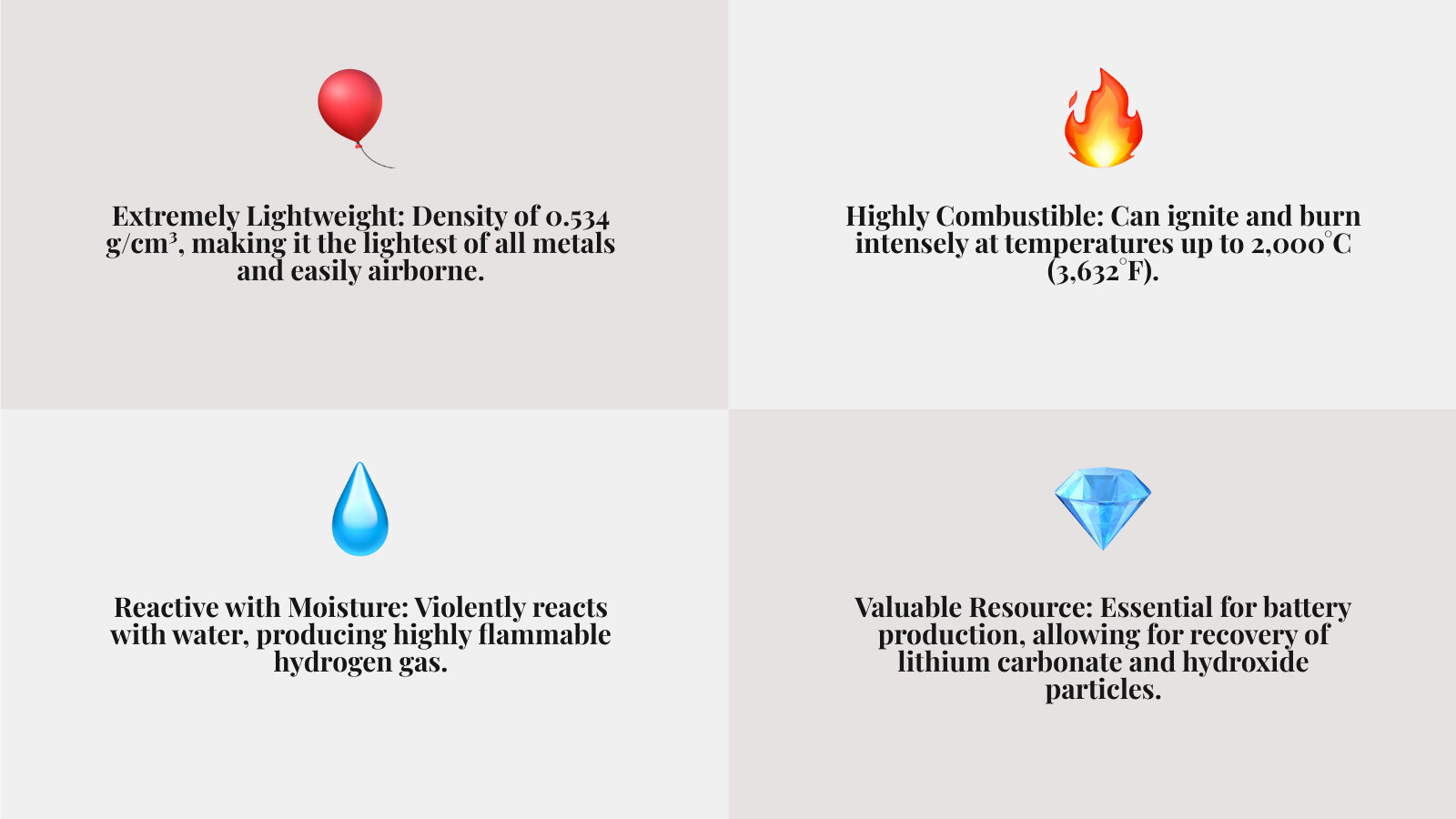
Lithium dust is exceptionally lightweight, with a density of approximately 0.534 g/cm3. This means it can easily become airborne, spreading throughout a facility and increasing exposure risks. Beyond its physical properties, lithium is highly reactive to its surrounding environment. When it comes into contact with moisture, steam, or water, it reacts vigorously, producing flammable hydrogen gas. This reaction alone presents a severe fire and explosion risk.
The hazards don’t stop there. Metal oxides present in lithium dust can cause health problems, particularly during mining and grinding operations. Direct contact with lithium dust can lead to irritation and chemical burns to the skin and eyes. Inhalation of these fine particulates, especially nanoparticles, poses a serious respiratory risk to workers.
The Fire and Explosion Risk
The combustibility of lithium dust is perhaps its most alarming characteristic. Since lithium is a metal, its dust is highly combustible. Lithium fires are categorized as Class D fires, which are reserved for combustible metals. These fires burn at incredibly high temperatures, often reaching 2,000° C (3,632° F). Imagine trying to put out a fire that hot with a regular extinguisher – it’s like bringing a squirt gun to a volcano!
What makes it even more dangerous is its reactivity with water. Using water or standard extinguishers on a lithium fire can actually exacerbate the situation, producing more flammable hydrogen gas and intensifying the blaze. This is why specialized Class D extinguishers are absolutely essential.
Furthermore, the tiny size of lithium dust particles increases its surface area, making it more prone to ignition and enabling it to burn faster. Nanoparticles of lithium are particularly hazardous; due to their high specific surface area, they can generate an explosion even without an external ignition source. This means a seemingly calm environment can quickly become a dangerous one if not properly managed.
To prevent such catastrophic events, regulations such as those issued by the National Fire Protection Association (NFPA) require facilities to test dust for its explosion potential, as measured by the Kst value. Understanding this value is critical for designing appropriate safety measures and containment systems, ensuring we never underestimate the explosive power of fine lithium dust.
The Dual Priorities: Safety and Resource Recovery
When we talk about lithium dust collection, we’re addressing a dual challenge: protecting people and processes while also preserving a valuable resource. It’s a balancing act where safety and efficiency go hand-in-hand.
On the one hand, effective dust collection is paramount for plant safety. It directly mitigates the severe risks of fire and explosion posed by combustible lithium dust. By capturing these airborne particles, we dramatically reduce the potential for ignition, protecting personnel, equipment, and the entire facility. Beyond explosion prevention, proper dust control significantly improves air quality within the plant, creating a healthier working environment and decreasing potential health hazards associated with inhaling metal oxides or experiencing skin and eye irritation.
On the other hand, the material we’re collecting is incredibly valuable. Lithium carbonate and lithium hydroxide particles, which become airborne during processing, are destined for industrial use, primarily in battery manufacturing. Capturing this dust isn’t just about waste management; it’s about recovering a precious resource that can be recycled back into the manufacturing process. This resource recovery translates directly into improved process efficiencies and a better return on investment, making lithium dust collection a smart economic decision as well as a safety imperative.
Meeting Regulatory and Safety Standards
Navigating industrial dust often feels like a maze of regulations, but when it comes to lithium dust, these standards are our guiding lights to safety. Compliance isn’t just about avoiding fines; it’s about saving lives and preventing catastrophic events.
Here are some key safety considerations we prioritize:
- NFPA Standards: The National Fire Protection Association (NFPA) sets crucial benchmarks for handling combustible materials. For lithium, NFPA 484, which addresses Combustible Metals, is particularly relevant. It outlines requirements for the safe handling, storage, and processing of combustible metals to prevent fires and explosions.
- Kst Value Testing: As mentioned earlier, specific regulations require facilities to test dust for its explosion potential (Kst value). This scientific assessment helps us understand the severity of a potential dust explosion and design appropriate protection systems.
- Good Housekeeping Practices: While advanced collection systems are vital, basic cleanliness remains a cornerstone of dust safety. Regular cleaning and preventing dust accumulation on surfaces are critical to minimizing the risk of fire and explosion.
- Maintenance Protocols: Consistent maintenance of dust collection equipment ensures peak efficiency. This includes regular inspection, cleaning, and replacement of filters and other components to prevent system failures that could lead to dangerous dust releases.
By adhering to these rigorous standards and implementing robust safety protocols, we ensure that our facilities and the processes within them are as safe and efficient as possible, allowing us to harness the power of lithium without succumbing to its dangers.
Mastering the Process: A Guide to Lithium Dust Collection
Lithium dust collection isn’t a one-size-fits-all solution; it’s a carefully orchestrated process that must account for every stage where dust can be generated. From the moment lithium is extracted to its final packaging, airborne particles are a constant concern.
Dust generation points occur throughout the entire lithium process stream:
- Mining: Whether it’s hard rock blasting and drilling or the evaporation ponds used for brine extraction, the initial stages of lithium acquisition can release significant amounts of particulate matter.
- Crushing and Grinding: Once extracted, lithium-bearing ores are crushed and milled to reduce particle size. This mechanical processing is a major source of fine lithium dust.
- Milling: Further refining, in which lithium is milled to micron levels (sometimes five microns or fewer), creates exceptionally light and reactive dust that is highly prone to becoming airborne.
- Drying and Packaging: Concentrated lithium slurries are dried, and the resulting powders are packaged, both of which can lead to dust emissions if not properly contained.
- Battery Manufacturing: Even in the later stages of battery component creation, handling and processing lithium materials can generate nuisance dust or valuable product that needs to be recovered.
In all these stages, the goal of dust collection can shift. Sometimes, we’re simply dealing with “nuisance dust” – particles that pose a health or safety risk but aren’t necessarily part of the final product. Other times, the collected dust is precisely the valuable lithium carbonate or hydroxide particles destined for industrial use, turning a potential hazard into a means of product recovery.
Key Design Factors for Lithium Dust Collection Systems
Designing an effective lithium dust collection system is a complex task that requires meticulous attention to detail and a deep understanding of lithium’s unique characteristics. It’s not just about sucking up dust; it’s about engineering a system that can safely and efficiently handle a highly reactive, combustible, and valuable material.
When we design these critical systems, we consider several key factors:
- Volume for Sizing: Accurately determining the air volume to be treated is fundamental for sizing the collector properly. Too small, and it won’t be effective; too large, and it’s inefficient.
- Inlet Location and Placement: Given the relatively light bulk density of lithium dust, the placement and design of the inlet are crucial. We need to ensure efficient capture without causing premature wear or inefficient dust loading.
- Air-to-Cloth Ratio vs. Interstitial Velocity: These are technical terms that dictate how much air flows through the filter media compared to the filter area. Optimizing these ratios ensures effective filtration and proper dust cake formation, which is vital for efficient cleaning cycles and filter longevity.
- Filter Media Selection: This is perhaps one of the most critical decisions. The media and bag type must be chosen based on the specific characteristics of the lithium dust, such as particle size, moisture levels, and temperature. The right media improves dust cake release and ensures optimal filtration efficiency.
- Explosion-Proof Venting and Electrical Systems: Because lithium dust is highly combustible, explosion protection is non-negotiable. Our systems incorporate explosion-proof venting, often with specialized panels, to safely release pressure in the event of an explosion. Electrical components are also rated for hazardous environments to prevent ignition sources.
- Voltage Requirements Based on Installation Location: Electrical requirements can vary depending on the specific facility and local codes, which we carefully account for during design and installation.
- Cleaning Cycles: Specialized designs consider the timing for cleaning cycles to maintain optimal performance and prevent excessive dust buildup on filters.
- Security for Proprietary Processes: For clients with unique lithium processing methods, we offer proprietary system designs that not only overcome process challenges but also maintain the security and confidentiality of their operations.
We believe that capturing every micron of lithium is essential for both safety and resource recovery. For more in-depth information on these critical design considerations, we encourage you to Download the white paper on capturing lithium dust. It’s a deep dive into how we tackle these challenges head-on.
Choosing the Right Dust Collection System
Selecting the ideal lithium dust collection system is about more than just picking a piece of equipment off a shelf. It requires a custom approach, recognizing that every lithium processing operation has its unique nuances. We pride ourselves on designing solutions that fit like a glove, rather than trying to force a square peg into a round hole.
Our process starts with a thorough understanding of your specific process requirements. What are your production volumes? What are the ambient conditions? What are your regulatory obligations? These questions help us define the scope and performance criteria for your system.
Crucially, we dig into the exact characteristics of your lithium dust. Is it fine or coarse? What are its moisture levels? How does it behave at different temperatures? Its reactivity and combustibility are always at the forefront of our minds. For instance, if your dust has higher moisture levels, this will significantly influence our filter media selection to ensure optimal dust cake release and prevent filter blinding. We also consider the particulate loading – how much dust is being generated – to size the system correctly for continuous, efficient operation.
Sly Solutions for Lithium Dust Collection
At Sly, LLC, we’ve been pioneers in air pollution control since 1902, with a legacy that includes the first cloth-type dust collector. For over 20 years, we’ve been assisting with lithium processing dust collection, bringing over 150 years of industry experience to every project. Our expertise means lithium processors can count on us with confidence, thanks to our reputation for service and quality.
When it comes to lithium dust collection, our solutions are engineered for precision and reliability. We primarily focus on dry collection technologies, which are ideal for recovering valuable dry lithium products and avoiding the reactivity of lithium with water. Our offerings include:
- CBR Pulse Jet Collectors (Baghouses): These are the workhorses of industrial dust collection. Our baghouses are custom-designed to handle the unique properties of lithium dust. Contaminated air is drawn through fabric filters that trap the dust, while filtered air is safely discharged. Accumulated dust is then released and collected for disposal or, more often, for recycling in the case of lithium. We engineer features like specific inlet placement and optimized air-to-cloth ratios to ensure maximum capture efficiency and filter life.
- Loading Spouts: For containing dust during the transfer of lithium material into containers or transportation, our loading spouts are designed to minimize fugitive emissions, keeping both the air clean and the valuable product contained.
Our systems are not just off-the-shelf products. We provide custom system design, fabrication, and installation, ensuring that every component is optimized for your specific challenges. This system integration and customization are key to overcoming the complexities of lithium dust, improving process efficiencies, and maintaining exceptional air quality within your facility.
Why Pleated Bags Are the Superior Choice
In baghouse filtration, not all filters are created equal. You might hear about “pleated bags” and “cartridges” almost interchangeably, but let us assure you, they are NOT the same; it’s all in the design. This distinction is particularly important when dealing with the fine, reactive, and combustible nature of lithium dust.
The design differences between pleated bags and traditional cartridge filters have significant performance implications:
- Dust Cake Release: Our pleated bags are engineered to improve dust cake release. This is crucial for lithium dust, which can be sticky or prone to agglomeration. Efficient dust cake shedding ensures that the filters remain clean and maintain optimal airflow, preventing pressure drops and maintaining collection efficiency.
- Filter Lifespan: A pleated bag, correctly specified for lithium dust characteristics and moisture levels, can offer a longer filter lifespan. This reduces maintenance frequency and operational costs, a welcome relief in any demanding industrial setting.
- Air-to-Cloth Ratio and Efficiency: The pleated design allows for a greater amount of filter media in a smaller footprint compared to traditional bags. This higher air-to-cloth ratio means more efficient filtration and greater capacity for handling high particulate loadings, all while maintaining excellent capture rates for even the finest lithium particles.
We’ve seen the difference firsthand. For a detailed comparison and to understand why pleated bags often emerge as the superior choice for lithium dust collection, we invite you to Download the case study on pleated bags for lithium dust collection. It highlights how intelligent filter design can make a tangible impact on safety, efficiency, and overall system performance.
Frequently Asked Questions about Lithium Dust
We understand that working with lithium dust can raise many questions, especially given its unique properties. Here are answers to some of the most common inquiries we receive:
What makes lithium dust so hazardous?
Lithium dust is hazardous due to its high reactivity with moisture, which produces flammable hydrogen gas, and its fine particle size, which makes it highly combustible and a respiratory risk. Nanoparticles can even explode without an external ignition source. Its extreme combustibility means it can burn at temperatures up to 2,000° C (3,632° F), posing severe fire and explosion threats. Additionally, metal oxides in the dust can cause health problems, including irritation and chemical burns to the skin and eyes, and respiratory issues upon inhalation.
What type of fire extinguisher is required for lithium fires?
Lithium fires are classified as Class D fires (combustible metals) and require a specialized Class D fire extinguisher. These extinguishers typically use agents like copper powder or graphite-based compounds that smother the fire and absorb heat without reacting with the lithium. It is critical never to use water, CO2, foam, or standard ABC/BC dry chemical extinguishers on a lithium fire, as these can react violently with the burning metal, intensifying the fire and potentially causing explosions.
What are the main goals of a lithium dust collection system?
The primary goals of a lithium dust collection system are multifaceted:
- Safety: To ensure worker safety by mitigating the severe risks of fire, explosion, and health hazards associated with combustible and reactive lithium dust.
- Compliance: To meet stringent air quality regulations and NFPA standards, preventing environmental pollution and ensuring a safe working environment.
- Resource Recovery: To improve process efficiency and economic viability by capturing and recycling valuable lithium particles (e.g., lithium carbonate/hydroxide) back into the manufacturing stream, turning a potential waste product into a recovered resource.
Schlussfolgerung
The journey of lithium dust collection is one of balancing immense opportunity with significant responsibility. As the demand for lithium continues its explosive growth, driven by the electrification of our world, the challenges posed by its fine, reactive, and combustible dust become increasingly critical. We’ve seen how lithium’s unique properties necessitate specialized solutions, where generic approaches simply won’t suffice.
Mastering lithium dust collection means understanding its dual nature: a precious resource on one hand and a potent safety hazard on the other. It demands a meticulous focus on protecting personnel from health risks, mitigating the potential for fires and explosions, and simultaneously recovering valuable material to improve process efficiency and sustainability.
This is where our expertise at Sly, LLC shines. With over a century of experience in air pollution control and decades dedicated to the specific complexities of lithium processing, we are uniquely positioned to be your trusted partner. We don’t just sell equipment; we design, fabricate, and install custom systems precisely engineered for your unique operational challenges, ensuring the cleanest possible air and the safest environment.
Don’t let lithium dust become a hazard or a missed opportunity. Let us help you steer these complexities with confidence. Improve your process efficiencies and the air quality within your facility.
Contact us today for a proprietary system design that can overcome your process challenges.